Q140 / 170 · Manipal (MET) 2015 · Physics
Find the inductance of a unit length of two parallel wires, each of radius $a$, whose centres are at distance $d$ apart and carry equal currents in opposite directions. Neglect the flux within the wire.
- A$\frac{\mu_0}{2 \pi} \ln \left(\frac{d-a}{a}\right)$
- Correct answerB$\frac{\mu_0}{\pi} \ln \left(\frac{d-a}{a}\right)$
- C$\frac{3 \mu_0}{\pi} \ln \left(\frac{d-a}{a}\right)$
- D$\frac{\mu_0}{3 \pi} \ln \left(\frac{d-a}{a}\right)$
Solution
Since, the wires are infinite, so the system of these two wires can be considered as closed rectangle of infinite length and breadth equal to $d$.
Flux through strip
$\phi=\int_a^{d-a} \frac{\mu_0 I}{2 \pi r}(l d r)=\frac{\mu_0 I}{2 \pi} \ln \left(\frac{d-a}{a}\right)$
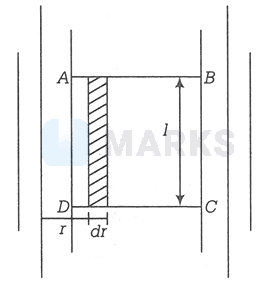
The other wire produces the same result, so the total flux through the rectangle $A B C D$ is $\phi_{\text {total }}=\frac{\mu_0 I I}{\pi} \ln \left(\frac{d-a}{a}\right)$ The total inductance of length 1 $L=\frac{I_{\text {total }}}{I}=\frac{\mu_0 I}{\pi} \ln \left(\frac{d-a}{a}\right)$ Inductance per unit length $=\frac{L}{l}=\frac{\mu_0}{\pi} \ln \left(\frac{d-a}{a}\right)$
The other wire produces the same result, so the total flux through the rectangle $A B C D$ is $\phi_{\text {total }}=\frac{\mu_0 I I}{\pi} \ln \left(\frac{d-a}{a}\right)$ The total inductance of length 1 $L=\frac{I_{\text {total }}}{I}=\frac{\mu_0 I}{\pi} \ln \left(\frac{d-a}{a}\right)$ Inductance per unit length $=\frac{L}{l}=\frac{\mu_0}{\pi} \ln \left(\frac{d-a}{a}\right)$
Hence, the correct answer is option: 'B'.