Q86 / 180 · NEET 2025 · Physics
Consider a water tank shown in the figure. It has one wall at $x=L$ and can be taken to be very wide in the $z$ direction. When filled with a liquid of surface tension $S$ and density $\rho$, the liquid surface makes angle $\theta_0\left(\theta_0 \ll 1\right)$ with the $x$-axis at $x=L$. If $y(x)$ is the height of the surface then the equation for $y(x)$ is:
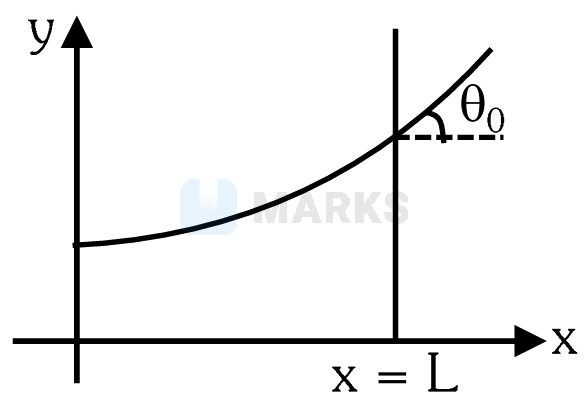
$\left(\operatorname{take} \theta(x)=\sin \theta(x)=\tan \theta(x)=\frac{d y}{d x}, g\right.$ is the acceleration due to gravity)
$\left(\operatorname{take} \theta(x)=\sin \theta(x)=\tan \theta(x)=\frac{d y}{d x}, g\right.$ is the acceleration due to gravity)
- A$\frac{\mathrm{d}^2 \mathrm{y}}{\mathrm{dx}^2}=\frac{\rho \mathrm{g}}{\mathrm{S}} \mathrm{x}$
- Correct answerB$\frac{\mathrm{d}^2 \mathrm{y}}{\mathrm{dx}^2}=\frac{\rho \mathrm{g}}{\mathrm{S}} y$
- C$\frac{\mathrm{d}^2 \mathrm{y}}{\mathrm{dx}^2}=\sqrt{\frac{\rho \mathrm{g}}{\mathrm{S}}}$
- D$\frac{d y}{d x}=\sqrt{\frac{\rho g}{S}} x$
Solution
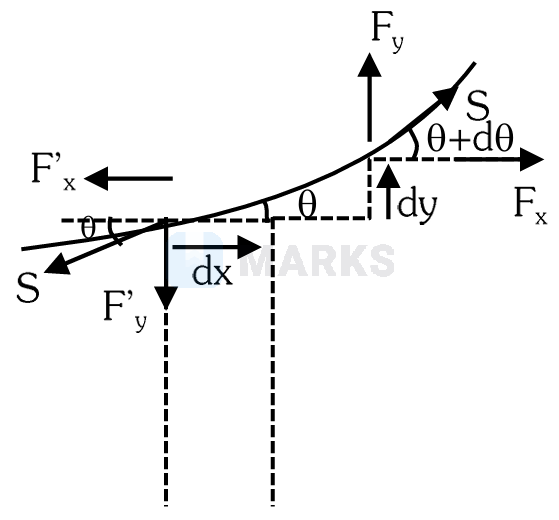
For the given element, (consider length d in Z direction) Net force in upward direction $=$ Weight $(S \sin (\theta+d \theta)-S \sin \theta) d=m g$ Angle is small $\therefore \sin \theta \approx \theta$ $\Rightarrow \frac{d \theta}{y d x}=\frac{\rho g}{S}...(1)$ $\begin{aligned} & \tan \theta=\frac{d y}{d x} \Rightarrow \text { Differentiating wrt } x \\ & \sec ^2 \theta \frac{d \theta}{d x}=\frac{d^2 y}{d x^2}...(2) \end{aligned}$ Put $d \theta$ from (2) in (1) d take $\cos \theta \approx 1$, we get $\frac{d^2 y}{d^2}=\frac{\rho g y}{S}$ $\text { Alternative Solution :}$
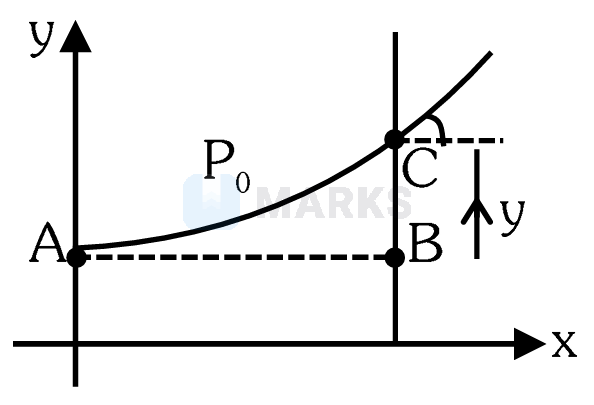
$\begin{aligned} & P_A=P_B=P_0 \\ & P_C=P_0-\rho g y \\ & P_C=P_0-\frac{S}{R} \\ & \rho g y=\frac{S}{R} \\ & \rho g y=S \frac{d^2 y}{d x^2} \\ & \frac{d^2 y}{d^2}=\frac{\rho g y}{S}\end{aligned}$ $\mathrm{R}=\frac{\left\{1+\left(\frac{\mathrm{dy}}{\mathrm{dx}}\right)^2\right\}^{3 / 2}}{\frac{\mathrm{~d}^2 \mathrm{y}}{\mathrm{dx}^2}}$ $\mathrm{dy} / \mathrm{dx}$ is very small $\begin{aligned} & \mathrm{R}=\frac{1}{\mathrm{~d}^2 \mathrm{y} / \mathrm{dx}^2} \\ & \frac{\mathrm{~d}^2 \mathrm{y}}{\mathrm{dx}^2}=\frac{1}{\mathrm{R}} \end{aligned}$
Hence, the correct answer is option: 'B'.