Q3 / 60 · NEST (NISER) 2020 (Session 2) · Biology
Conjugation in $E$. coli is a microbial process wherein conjugative plasmids are transferred from one bacterium to another that does not possess it. This requires physical contact between the cells involved in the transfer. In an experiment performed in a sterilized U-tube, strains $\mathbf{P}$ (resistance to ampicillin encoded in its plasmid) and Q (resistance to tetracycline encoded in its genome) were grown in an appropriate medium without an antibiotic. A $0.22 \mu \mathrm{~m}$ pore size nitrocellulose membrane placed in between the two arms serves as a partition. In a parallel identical experiment the $0.22 \mu \mathrm{~m}$ membrane was replaced by a $30 \mu \mathrm{~m}$ nitrocellulose membrane. After allowing enough time for the conjugation process to occur, an aliquot from each arm is plated on either ampicillin or tetracyclin antibiotic containing plate. Choose the correct statement about the outcome of the experiment.
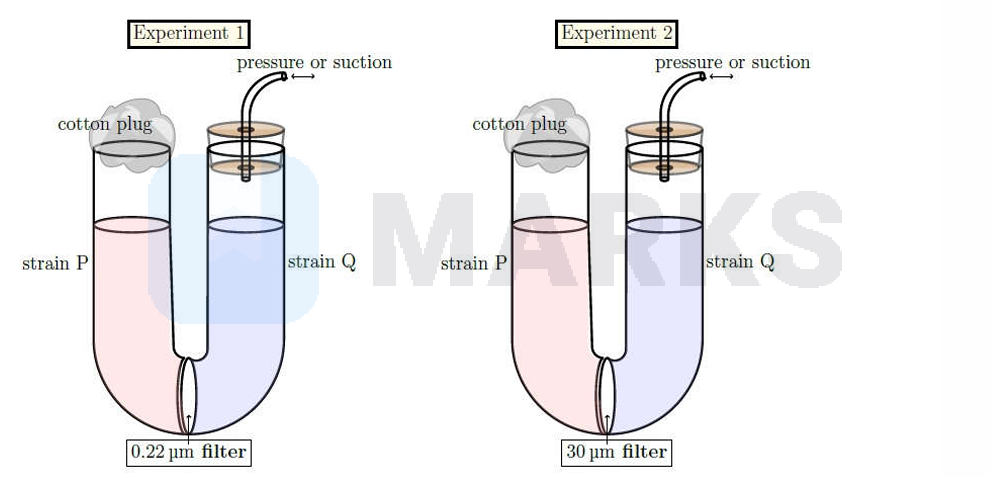
- AStrain Q would be ampicillin resistant in experiment 1.
- BStrain P would be tetracycline resistant in experiment 2.
- Correct answerCStrain Q would be ampicillin resistant in experiment 2.
- DStrain P would be tetracycline resistant in experiment 1.
Hence, the correct answer is option: 'C'.