Q14 / 75 · JEE Main 2026 (23 January Shift 1) · Chemistry
Compound ' P ' undergoes the following sequence of reactions :

' $\mathrm{P}^{\prime}$ is :
' $\mathrm{P}^{\prime}$ is :
- A
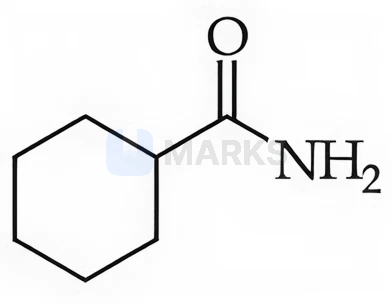
- B
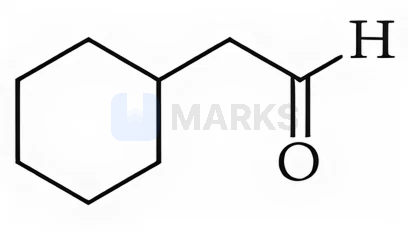
- C
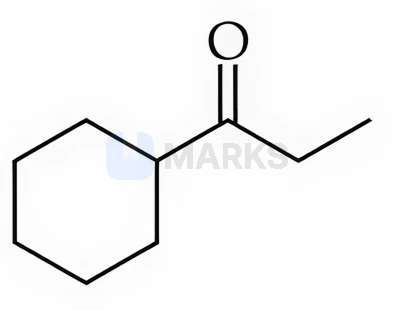
- Correct answerD
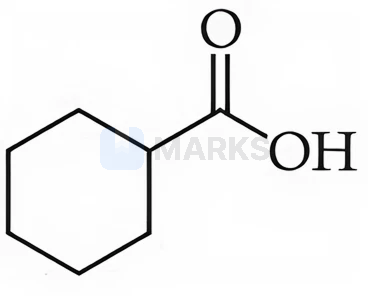
Solution
The final product is cyclohexyl isocyanide ($C_6H_{11}NC$).
Working backwards from the final product:
The last step involves $CHCl_3$ and $KOH$ (alc), which is the Carbylamine reaction.
This reaction converts a primary amine ($R-NH_2$) into an isocyanide ($R-NC$). Thus, the intermediate before this step must be cyclohexylamine ($C_6H_{11}NH_2$).
The step before cyclohexylamine involves $Br_2$ and $KOH$, which is the Hoffmann Bromamide Degradation reaction.
This reaction converts an amide ($R-CONH_2$) into a primary amine ($R-NH_2$) with one less carbon atom.
Therefore, the amide 'Q' must be cyclohexanecarboxamide ($C_6H_{11}CONH_2$).
The first step converts 'P' into 'Q' using $NH_3$ and heat.
Carboxylic acids react with $NH_3$ followed by heating to form amides.
Thus, 'P' must be cyclohexanecarboxylic acid ($C_6H_{11}COOH$).
Reaction sequence:
$C_6H_{11}COOH$ (P) $\xrightarrow{NH_3, \Delta} C_6H_{11}CONH_2$ (Q)
$C_6H_{11}CONH_2$ (Q) $\xrightarrow{Br_2, KOH} C_6H_{11}NH_2$ (Cyclohexylamine)
$C_6H_{11}NH_2 \xrightarrow{CHCl_3, KOH} C_6H_{11}NC$ (Cyclohexyl isocyanide)
Comparing with the options, 'P' is cyclohexanecarboxylic acid, which corresponds to option (4).
Hence, the correct answer is option: 'D'.