Q75 / 180 · NEET 2026 (Cancelled) · Chemistry
Compound P ($\text{C}_8\text{H}_8\text{O}$) gives a red orange precipitate with $2,4$-DNP reagent and it does not reduce Fehling's reagent. On drastic oxidation with chromic acid, P gives an aromatic product Q that produces effervescence on treating with aq. $\text{NaHCO}_3$. Compounds P and Q, respectively, are :
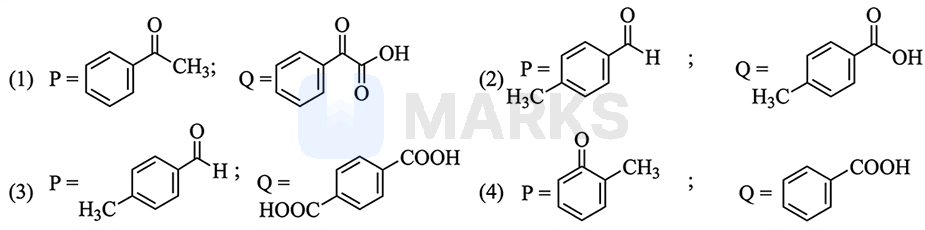
- A1
- B2
- C3
- Correct answerD4
Solution
Compound P ($\text{C}_8\text{H}_8\text{O}$) gives a red-orange precipitate with $2,4$-DNP reagent, indicating the presence of a carbonyl group.
P does not reduce Fehling's reagent, which implies it is either a ketone or an aromatic aldehyde.
The requirement of "drastic oxidation" strongly suggests that P is a ketone. Ketones resist mild oxidation and require drastic conditions (such as chromic acid) to undergo C-C bond cleavage, whereas aldehydes are easily oxidized.
Acetophenone ($\text{C}_6\text{H}_5\text{COCH}_3$) is a ketone that fits the molecular formula $\text{C}_8\text{H}_8\text{O}$.
Drastic oxidation of acetophenone with chromic acid cleaves the methyl group to yield benzoic acid ($\text{C}_6\text{H}_5\text{COOH}$), which is compound Q.
Benzoic acid is an aromatic carboxylic acid that reacts with aqueous $\text{NaHCO}_3$ to produce effervescence of $\text{CO}_2$ gas.
Therefore, P is acetophenone and Q is benzoic acid.
Answer: 4
Hence, the correct answer is option: 'D'.