Q127 / 160 · TS EAMCET 2020 (11 Sep Shift 1) · Physics
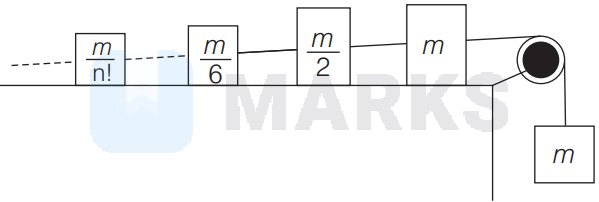
An infinite number of masses are placed on a frictionless table and they are connected via massless strings. Their masses follow the sequence, $m, \frac{m}{2}, \frac{m}{6}, \ldots \ldots \ldots . . . \frac{m}{n !}, \ldots \ldots . .$. and they are further connected to a mass $m$ that hangs over a massless pulley. The acceleration of the hanging mass is
- A$\frac{g}{e-1}$
- B$\frac{g}{e+1}$
- Correct answerC$\frac{g}{e}$
- D$\frac{g}{2 e}$
Solution
The given situation is shown in the following figure
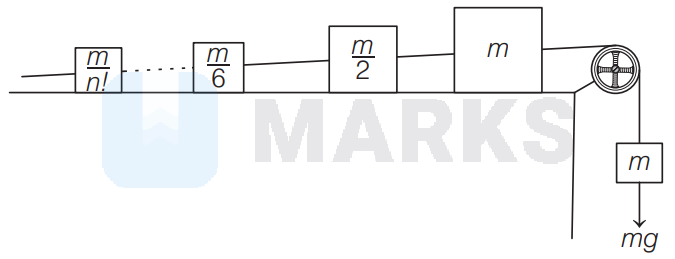
Effective mass of the system of $n$ masses placed on the table, $M=m+\frac{m}{2}+\frac{m}{6}+\ldots+\frac{m}{n !}$ $=m\left(1+\frac{1}{2}+\frac{1}{6}+\ldots+\frac{1}{n !}\right)$ $=m\left(\frac{1}{1 !}+\frac{1}{2 !}+\frac{1}{3 !}+\ldots+\frac{1}{n !}\right)$ $=m\left(1+\frac{1}{1 !}+\frac{1}{2 !}+\frac{1}{3 !}+\ldots+\frac{1}{n !}-1\right)$ $M=m(e-1)$ $\left[\because e=1+\frac{1}{1 !}+\frac{1}{2 !}+\frac{1}{3 !}+\ldots+\frac{1}{n !}\right]$ The given system of masses can be redrawn as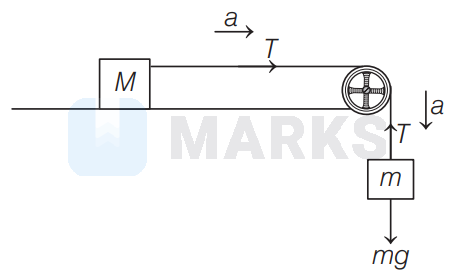
If $a$ be the acceleration of system of masses, then according to Newton's second law of motion, $T=M a \Rightarrow T=m(e-1) a$ $\ldots(i)$ and $m g-T=m a \Rightarrow T=m g-m a$ $T=m(g-a)$ $\ldots(ii)$ From Eq. (i) and Eq. (ii), we get $m(e-1) a=m(g-a) \Rightarrow a=g / e$
Effective mass of the system of $n$ masses placed on the table, $M=m+\frac{m}{2}+\frac{m}{6}+\ldots+\frac{m}{n !}$ $=m\left(1+\frac{1}{2}+\frac{1}{6}+\ldots+\frac{1}{n !}\right)$ $=m\left(\frac{1}{1 !}+\frac{1}{2 !}+\frac{1}{3 !}+\ldots+\frac{1}{n !}\right)$ $=m\left(1+\frac{1}{1 !}+\frac{1}{2 !}+\frac{1}{3 !}+\ldots+\frac{1}{n !}-1\right)$ $M=m(e-1)$ $\left[\because e=1+\frac{1}{1 !}+\frac{1}{2 !}+\frac{1}{3 !}+\ldots+\frac{1}{n !}\right]$ The given system of masses can be redrawn as
If $a$ be the acceleration of system of masses, then according to Newton's second law of motion, $T=M a \Rightarrow T=m(e-1) a$ $\ldots(i)$ and $m g-T=m a \Rightarrow T=m g-m a$ $T=m(g-a)$ $\ldots(ii)$ From Eq. (i) and Eq. (ii), we get $m(e-1) a=m(g-a) \Rightarrow a=g / e$
Hence, the correct answer is option: 'C'.