Q128 / 160 · TS EAMCET 2020 (11 Sep Shift 1) · Physics
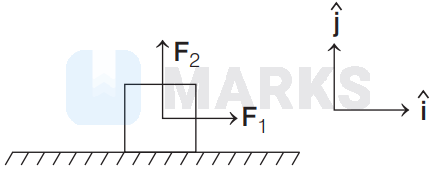
A block of mass $m=2 \mathrm{~kg}$ is initially at rest on a horizontal surface. A horizontal force $\mathbf{F}_1=(6 \mathrm{~N}) \hat{\mathbf{i}}$ and a vertical force $\mathbf{F}_2=(10 \mathrm{~N}) \hat{\mathbf{j}}$ are then applied to the block. The coefficients of static friction and kinetic friction for the block and the surfaces are 0.4 and 0.25 , respectively. The magnitude of the frictional force acting on the block is (assume, $g=10 \mathrm{~m} / \mathrm{s}^2$ )
- Correct answerA$2.5 \mathrm{~N}$
- B$4.0 \mathrm{~N}$
- C$3.3 \mathrm{~N}$
- D$3.0 \mathrm{~N}$
Solution
In addition to the forces shown in figure, there will be another upcoming normal force $\mathbf{F}_N$ exerted by the floor on the block. Using Newton's second law in horizontal and vertical directions, we get
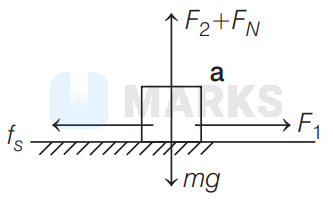
In horizontal direction, $F_1-f_s=m a$ $\ldots(\mathrm{i})$ and in vertical direction, $F_2+F_N-m g=0$ $\ldots(\mathrm{ii})$ Given, $F_2=10 \mathrm{~N}, m=2 \mathrm{~kg}$ and $g=10 \mathrm{~ms}^{-2}$ $\Rightarrow \quad 10+F_N-m g=0$ or $\quad F_N=(2 \times 10)-10=10 \mathrm{~N}$ $\ldots(\mathrm{iii})$ Hence, static friction $f_s =\mu_s F_N$ $=0.4 \times 10=4 \mathrm{~N}$ $\ldots(\mathrm{iv})$ Clearly, it is lesser than static force $F_1(=6 \mathrm{~N})$, so block will move, i.e. we are dealing with kinetic friction now. Hence, friction force (kinetic) acting on the body is $f_k=\mu_k F_N=0.25 \times 10=2.5 \mathrm{~N}$
In horizontal direction, $F_1-f_s=m a$ $\ldots(\mathrm{i})$ and in vertical direction, $F_2+F_N-m g=0$ $\ldots(\mathrm{ii})$ Given, $F_2=10 \mathrm{~N}, m=2 \mathrm{~kg}$ and $g=10 \mathrm{~ms}^{-2}$ $\Rightarrow \quad 10+F_N-m g=0$ or $\quad F_N=(2 \times 10)-10=10 \mathrm{~N}$ $\ldots(\mathrm{iii})$ Hence, static friction $f_s =\mu_s F_N$ $=0.4 \times 10=4 \mathrm{~N}$ $\ldots(\mathrm{iv})$ Clearly, it is lesser than static force $F_1(=6 \mathrm{~N})$, so block will move, i.e. we are dealing with kinetic friction now. Hence, friction force (kinetic) acting on the body is $f_k=\mu_k F_N=0.25 \times 10=2.5 \mathrm{~N}$
Hence, the correct answer is option: 'A'.