Q175 / 180 · COMEDK 2024 (Afternoon Shift) · Physics
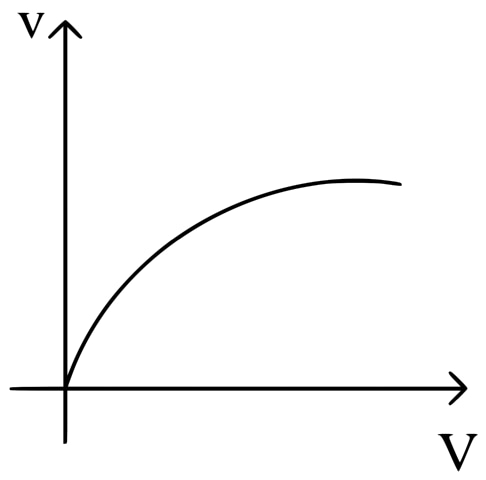
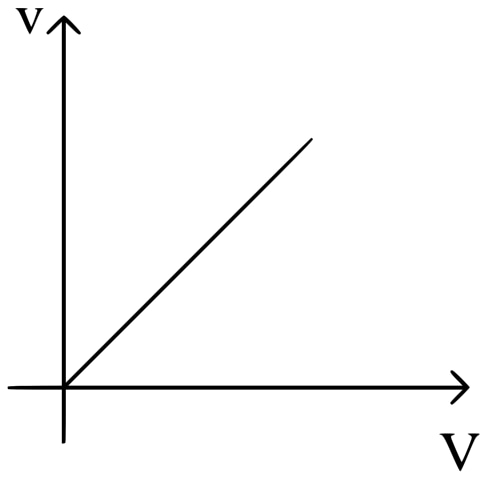
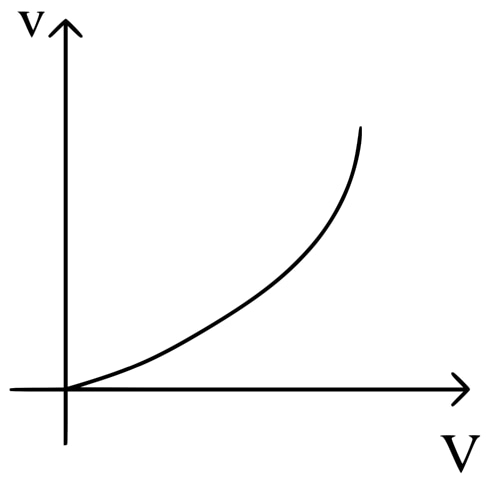
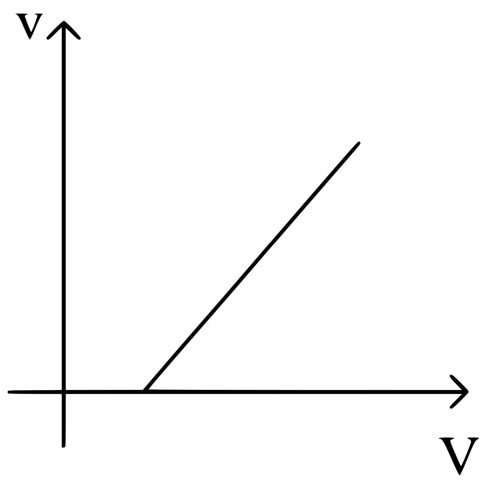
An electron starting from rest and moving with the velocity $\mathrm{v}$ through a potential difference $\mathrm{V}$ is shown by the graphs below. Identify the correct graph.
- Correct answerA
- B
- C
- D
Solution
The kinetic energy gained by an electron of mass $m$ and charge $e$ when accelerated through a potential difference $V$ is given by the work-energy theorem as $K = eV$.
The kinetic energy is also expressed as $K = \dfrac{1}{2}mv^2$, where $v$ is the velocity of the electron.
Equating the two expressions, we have $\dfrac{1}{2}mv^2 = eV$.
Solving for velocity $v$, we get $v^2 = \dfrac{2eV}{m}$, which implies $v = \sqrt{\dfrac{2e}{m}} \sqrt{V}$.
This equation is of the form $v = k\sqrt{V}$, where $k = \sqrt{\dfrac{2e}{m}}$ is a constant.
The relationship between $v$ and $V$ is a parabolic curve where $v$ increases with $V$ but with a decreasing slope as $V$ increases, which corresponds to the first graph.
Answer:
Hence, the correct answer is option: 'A'.