Q168 / 180 · COMEDK 2026 (9 May Shift 1) · Physics
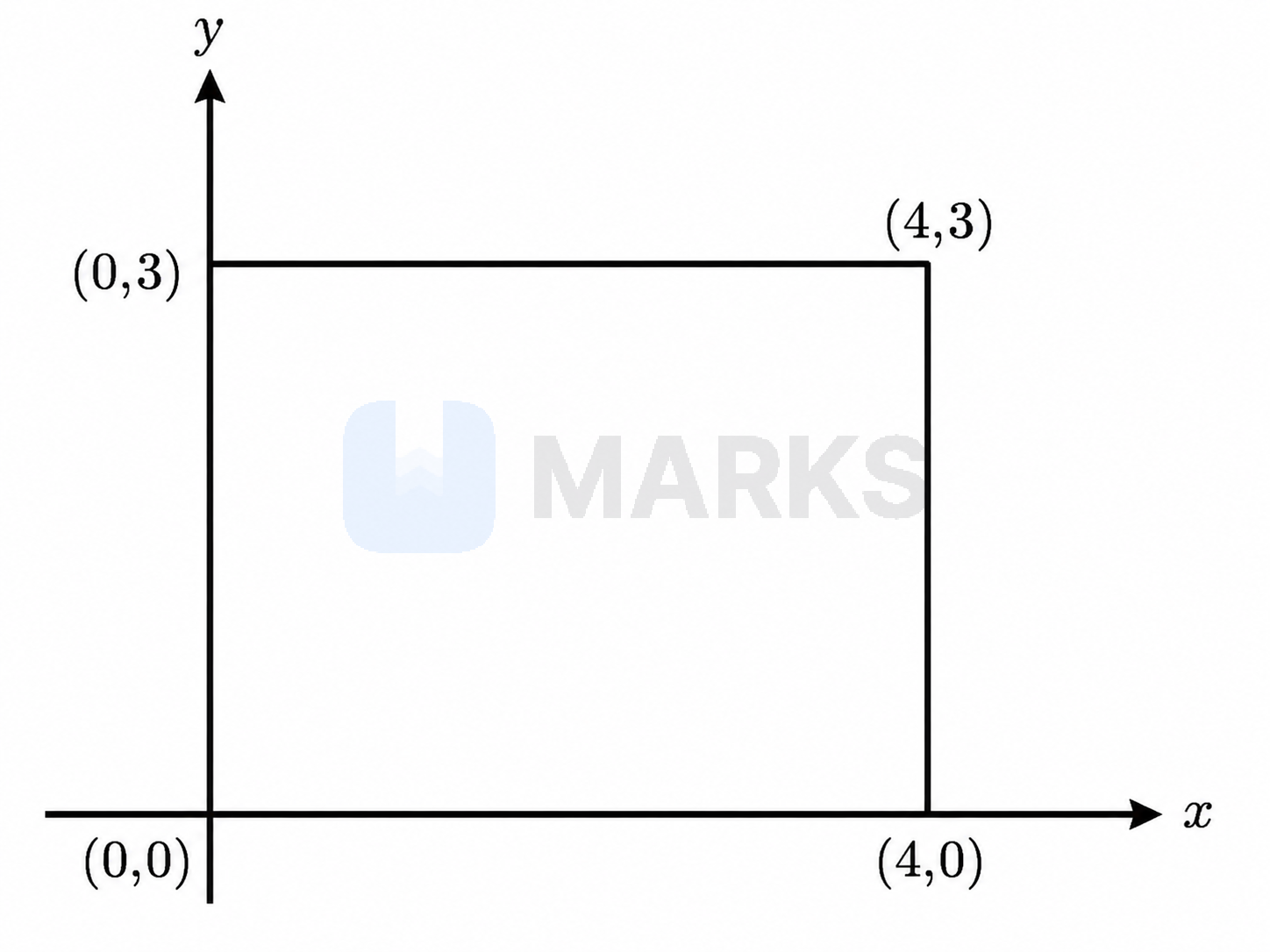
Two charges 1C and 2C are placed at coordinates (0,3) and (4,3) respectively in an XY plane. What is the work done to put a 30C charge at the origin of the coordinate system?
Two charges 1C and 2C are placed at coordinates (0,3) and (4,3) respectively in an XY plane. What is the work done to put a 30C charge at the origin of the coordinate system?
- Correct answerA$198 \times 10^9\ J$
- B$1.98 \times 10^9\ J$
- C$3.98 \times 10^9\ J$
- D$19.8 \times 10^9\ J$
Solution
The potential at the origin due to the charges $q_1$ and $q_2$ is given by $V = V_1 + V_2$.
The distance of the first charge $q_1 = 1 \text{ C}$ at $(0, 3)$ from the origin is $r_1 = 3 \text{ m}$.
The distance of the second charge $q_2 = 2 \text{ C}$ at $(4, 3)$ from the origin is $r_2 = \sqrt{4^2 + 3^2} = 5 \text{ m}$.
The total electric potential at the origin is $V = \dfrac{1}{4\pi\epsilon_0} \left( \dfrac{q_1}{r_1} + \dfrac{q_2}{r_2} \right)$.
Substituting the given values, we get $V = 9 \times 10^9 \left( \dfrac{1}{3} + \dfrac{2}{5} \right)$.
$V = 9 \times 10^9 \left( \dfrac{5 + 6}{15} \right) = 9 \times 10^9 \left( \dfrac{11}{15} \right) = 6.6 \times 10^9 \text{ V}$.
The work done to bring a charge $q_3 = 30 \text{ C}$ to the origin is $W = q_3 V$.
$W = 30 \times 6.6 \times 10^9 = 198 \times 10^9 \text{ J}$.
Hence, the correct answer is option: 'A'.