Q49 / 59 · KVPY 2013 (SA) · Physics
A tall tank filled with water has an irregular shape as shown. The wall $\mathrm{CD}$ makes an angle of $45^{\circ}$ with the horizontal; the wall $\mathrm{AB}$ is normal to the base $\mathrm{BC}$. The lengths $\mathrm{AB}$ and $\mathrm{CD}$ are much smaller than the height h of water (figure not to scale).
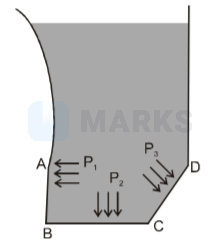
Let $\mathrm{P}_{1}, \mathrm{P}_{2}$ and $\mathrm{P}_{3}$ be the pressures exerted by the water on the wall $\mathrm{AB}$, base $\mathrm{BC}$ and the wall $\mathrm{CD}$ respectively. Density of water is $\rho$ and $g$ is acceleration due to gravity. Then, approximately
Let $\mathrm{P}_{1}, \mathrm{P}_{2}$ and $\mathrm{P}_{3}$ be the pressures exerted by the water on the wall $\mathrm{AB}$, base $\mathrm{BC}$ and the wall $\mathrm{CD}$ respectively. Density of water is $\rho$ and $g$ is acceleration due to gravity. Then, approximately
- Correct answerA$P_{1}=P_{2}=P_{3}$
- B$P_{1}=0, P_{3}=\frac{1}{\sqrt{2}} P_{2}$
- C$P_{1}=P_{3}=\frac{1}{\sqrt{2}} P_{2}$
- D$P_{1}=P_{3}=0, P_{2}=h \rho g$
Solution
All are nearly at same height hence $\mathrm{P}_{1}=\mathrm{P}_{2}=\mathrm{P}_{3}$
Hence, the correct answer is option: 'A'.