Q89 / 91 · KVPY 2018 (SB/SX) · Physics
A spiral galaxy can be approximated as an infinitesimally thin disc of a uniform surface mass density (mass per unit area) located at Two stars and start from rest from heights and ( radial extent of the disc), respectively and fall towards the disc, cross over to the other side and execute periodic oscillations. The ratio of time periods of and is
- A
- Correct answerB
- C
- D
Solution
Spiral galaxies consists of flat rotating disc containing stars, gas and dust.
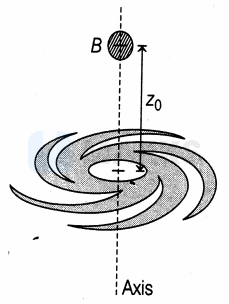
Now, we thought of spiral galaxy in form of a disc.
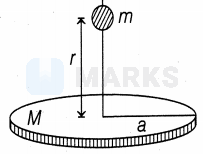
Gravitational intensity at distance $r$ over axis is
Using binomial approximation, we have
So, forces on planet and are
Accelerations of and respectively, are
and
If and are time periods of oscillations of and , then
[we use as in case of a linear oscillator]
Hence, the correct answer is option: 'B'.