Q154 / 180 · COMEDK 2024 (Evening Shift) · Physics
A solid cylinder of mass $2 \mathrm{~kg}$ and radius $0.2 \mathrm{~m}$ is rotating about its own axis without friction with angular velocity $5 \mathrm{~rad} \mathrm{s}^{-1}$. A particle of mass $1 \mathrm{~kg}$ moving with a velocity of $5 \mathrm{~ms}^{-1}$ strikes the cylinder and sticks to it as shown in figure.
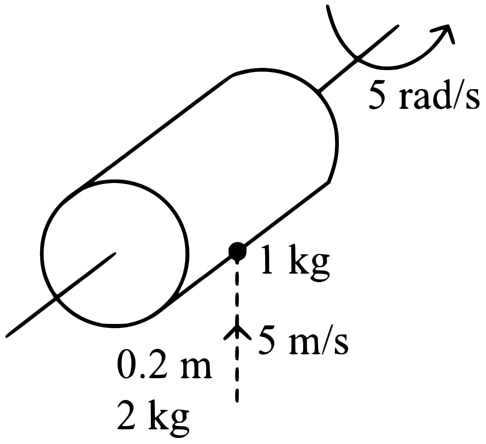 The angular velocity of the system after the particle sticks to it will be
- Correct answerA$15.0 \mathrm{~rad~s}^{-1}$
- B$10.0 \mathrm{~rad~s}^{-1}$
- C$30.0 \mathrm{~rad~s}^{-1}$
- D$12.0 \mathrm{~rad~s}^{-1}$
Solution
The initial angular momentum of the system about the axis of rotation is the sum of the angular momentum of the cylinder and the angular momentum of the particle. The cylinder is rotating about its own axis, so its angular momentum is $L_{cyl} = I \omega = (\dfrac{1}{2} M R^2) \omega$.
Given $M = 2 \text{ kg}$, $R = 0.2 \text{ m}$, and $\omega = 5 \text{ rad s}^{-1}$, we have $I = \dfrac{1}{2} \times 2 \times (0.2)^2 = 0.04 \text{ kg m}^2$. Thus, $L_{cyl} = 0.04 \times 5 = 0.2 \text{ kg m}^2 \text{s}^{-1}$.
The particle of mass $m = 1 \text{ kg}$ moves with velocity $v = 5 \text{ m s}^{-1}$ at a perpendicular distance $R = 0.2 \text{ m}$ from the axis. Its angular momentum is $L_{part} = m v R = 1 \times 5 \times 0.2 = 1.0 \text{ kg m}^2 \text{s}^{-1}$.
The total initial angular momentum is $L_{initial} = L_{cyl} + L_{part} = 0.2 + 1.0 = 1.2 \text{ kg m}^2 \text{s}^{-1}$.
After the particle sticks to the cylinder, the new moment of inertia is $I' = I + m R^2 = 0.04 + 1 \times (0.2)^2 = 0.04 + 0.04 = 0.08 \text{ kg m}^2$.
By conservation of angular momentum, $L_{initial} = L_{final} = I' \omega'$.
$1.2 = 0.08 \times \omega'$.
$\omega' = \dfrac{1.2}{0.08} = \dfrac{120}{8} = 15.0 \text{ rad s}^{-1}$.
Answer: $15.0 \mathrm{~rad~s}^{-1}$
Hence, the correct answer is option: 'A'.