Q3 / 60 · NEST (NISER) 2017 · Biology
A piece of liver tissue is homogenized in a laboratory and the homogenate is subjected to sequential centrifugation at increasing speeds (expressed in $\times \mathrm{g}$ ). Centrifugation is used to separate sub-cellular components based on size and density. The steps carried out in the experiment are shown below.
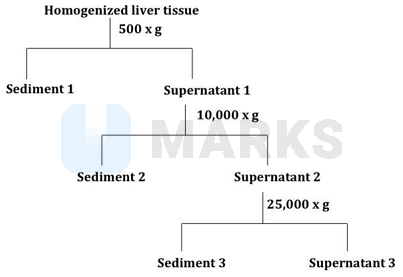
Sediments 1,2 and 3 would most likely contain:
Sediments 1,2 and 3 would most likely contain:
- A$\begin{array}{lll}\text { 1: Nuclei } & \text { 2: Ribosomes } & \text { 3: Mitochondria }\end{array}$
- Correct answerB1: Nuclei 2: Mitochondria 3: Lysosomes
- C1: Lysosomes $\quad$ 2: Mitochondria $\quad$ 3: Nuclei
- D1: Ribosomes $\quad$ 2: Nuclei $\quad$ 3: Mitochondria
Hence, the correct answer is option: 'B'.