Q123 / 160 · TS EAMCET 2020 (11 Sep Shift 1) · Physics
A person moves $30 \mathrm{~m}$ North and then $20 \mathrm{~m}$ towards East and finally $30 \sqrt{2} \mathrm{~m}$ in South-West direction. The displacement of the person from the origin will be
- A$10 \mathrm{~m}$ along North
- B$10 \mathrm{~m}$ along South
- Correct answerC$10 \mathrm{~m}$ along West
- Dzero
Solution
Let us use the conventional directions, as shown in figure, to solve this problem.
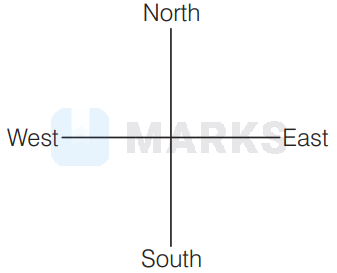
According to question, let us draw the diagram.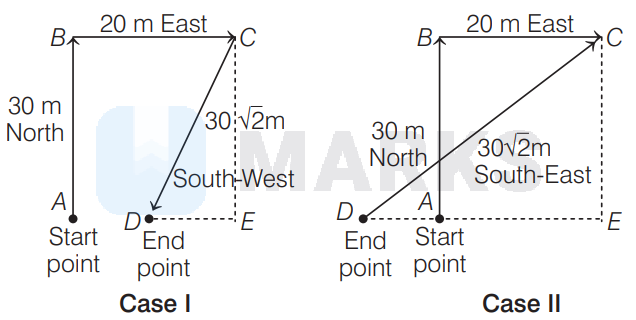
There are two possible diagrams. Clearly, $\quad C E=A B=30 \mathrm{~m} \Rightarrow C D=30 \sqrt{2} \mathrm{~m}$ Using Pythagoras theorem, $(C E)^2+(D E)^2=(C D)^2$ $\Rightarrow(D E)^2=(30 \sqrt{2})^2-(30)^2=1800-900=900 \mathrm{~m}$ $\Rightarrow \quad D E=30 \mathrm{~m}$ Now, it is clear that Case I is not possible. Using Case II, Clearly, displacement of the person is End point - Start point $=D A$ (along West) and $\quad D A=D E-A E$ $=30 \mathrm{~m}-20 \mathrm{~m}=10 \mathrm{~m} \quad$ (along West)
According to question, let us draw the diagram.
There are two possible diagrams. Clearly, $\quad C E=A B=30 \mathrm{~m} \Rightarrow C D=30 \sqrt{2} \mathrm{~m}$ Using Pythagoras theorem, $(C E)^2+(D E)^2=(C D)^2$ $\Rightarrow(D E)^2=(30 \sqrt{2})^2-(30)^2=1800-900=900 \mathrm{~m}$ $\Rightarrow \quad D E=30 \mathrm{~m}$ Now, it is clear that Case I is not possible. Using Case II, Clearly, displacement of the person is End point - Start point $=D A$ (along West) and $\quad D A=D E-A E$ $=30 \mathrm{~m}-20 \mathrm{~m}=10 \mathrm{~m} \quad$ (along West)
Hence, the correct answer is option: 'C'.