Q181 / 200 · Manipal (MET) 2012 · Physics
A mass 3 m , initially at rest at the origin explodes into three fragments of equal mass. Two of the fragments have speed $v$ each and move perpendicular to each other. The third fragment will move with a speed
- A$\frac{v}{\sqrt{2}}$
- B$\frac{v}{2}$
- C$v$
- Correct answerD$v \sqrt{2}$
Solution
From law of conservation of momentum,
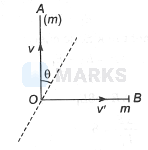
$\begin{aligned} & m v-m v^{\prime} \cos \theta=0 \qquad ...\mathrm{(i)} \\ & m v-m v^{\prime} \sin \theta=0 \qquad ...\mathrm{(ii)} \end{aligned}$ From Eqs. (i) and (ii), we get $\begin{aligned} & \theta=45^{\circ} \\ & v^{\prime}=\frac{v}{\cos \theta}=v \sqrt{2} \end{aligned}$
$\begin{aligned} & m v-m v^{\prime} \cos \theta=0 \qquad ...\mathrm{(i)} \\ & m v-m v^{\prime} \sin \theta=0 \qquad ...\mathrm{(ii)} \end{aligned}$ From Eqs. (i) and (ii), we get $\begin{aligned} & \theta=45^{\circ} \\ & v^{\prime}=\frac{v}{\cos \theta}=v \sqrt{2} \end{aligned}$
Hence, the correct answer is option: 'D'.