Q58 / 67 · NEST (NISER) 2021 (Session 1) · Physics
A long wire with a uniform linear charge density $\lambda$ is placed along the common axis of two long coaxial thin cylindrical shells of radii $R_1$ and $R_2$ (see figure). The outer shell carries a uniform surface charge density $-\lambda / 2 \pi R_2$. Take the zero of the potential at infinity along the radial direction. The potential at a distance $r$ from the axis where $R_1 \lt r \lt R_2$ is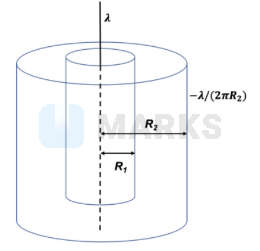
- A$\frac{\lambda}{4 \pi \epsilon_0} \ln \left(R_2 / r\right)$.
- Correct answerB$\frac{\lambda}{2 \pi \epsilon_0} \ln \left(R_2 / r\right)$
- C$\frac{\lambda}{2 \pi \epsilon_0} \ln \left(r / R_2\right)$.
- D$\frac{\lambda}{4 \pi \epsilon_0} \ln \left(r / R_2\right)$.
Hence, the correct answer is option: 'B'.