Q125 / 125 · BITSAT 2015 · Physics
A long straight wire along the $Z$ -axis carries a current I in the negative $Z$ -direction. The
magnetic vector field $\vec{B}$ at a point having coordinates $(x, y)$ in the $Z=0$ plane is
- Correct answerA$\frac{\mu_{0} I(y \hat{i}-x \hat{j})}{2 \pi\left(x^{2}+y^{2}\right)}$
- B$\frac{\mu_{0} I(x \hat{i}+y \hat{j})}{2 \pi\left(x^{2}+y^{2}\right)}$
- C$\frac{\mu_{0} I(x \hat{j}-y \hat{i})}{2 \pi\left(x^{2}+y^{2}\right)}$
- D$\frac{\mu_{0} I(x \hat{i}-y \hat{j})}{2 \pi\left(x^{2}+y^{2}\right)}$
Solution
The wire carries a current $I$ in the negative $z$ -direction. We have to consider the
magnetic vector field $\vec{B}$ at $(x, y)$ in the $z=0$ plane.
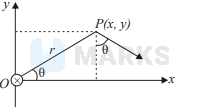
Magnetic field $\vec{B}$ is perpendicular to $O P$ $\therefore \vec{B}=B \sin \theta \hat{i}-B \cos \theta \hat{j}$ $$ \begin{array}{l} \sin \theta=\frac{y}{r}, \cos \theta=\frac{x}{r} B=\frac{\mu_{0} I}{2 \pi r} \\ \therefore \quad \vec{B}=\frac{\mu_{0} I}{2 \pi r^{2}}(y \hat{i}-x \hat{j}) \end{array} $$ or $\quad \vec{B}=\frac{\mu_{0} I(y \hat{i}-x \hat{j})}{2 \pi\left(x^{2}+y^{2}\right)}$
Magnetic field $\vec{B}$ is perpendicular to $O P$ $\therefore \vec{B}=B \sin \theta \hat{i}-B \cos \theta \hat{j}$ $$ \begin{array}{l} \sin \theta=\frac{y}{r}, \cos \theta=\frac{x}{r} B=\frac{\mu_{0} I}{2 \pi r} \\ \therefore \quad \vec{B}=\frac{\mu_{0} I}{2 \pi r^{2}}(y \hat{i}-x \hat{j}) \end{array} $$ or $\quad \vec{B}=\frac{\mu_{0} I(y \hat{i}-x \hat{j})}{2 \pi\left(x^{2}+y^{2}\right)}$
Hence, the correct answer is option: 'A'.