Q123 / 150 · MHT CET 2026 (11 April Shift 1) · Physics
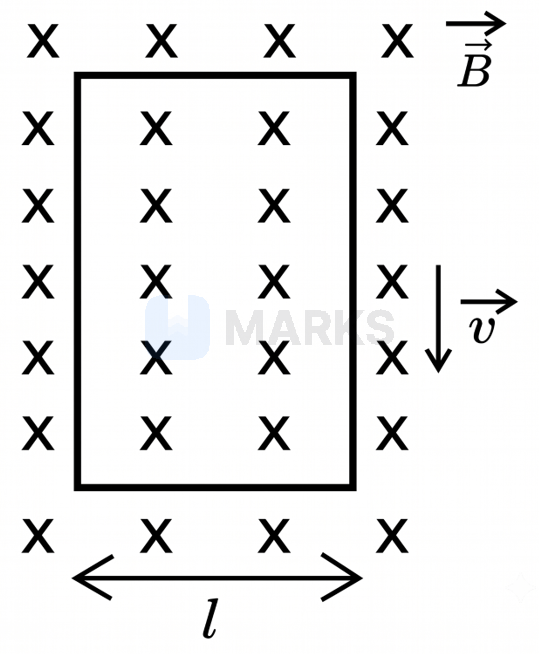
A long rectangular conducting loop of width '$l$' mass '$m$' and resistance '$R$' is placed partly in a perpendicular magnetic field '$B$'. With what velocity should it be pushed downwards so that it may continue to fall without any acceleration? ($g$ = acceleration due to gravity)
- A$\dfrac{B^2 l^2 R^2}{mg}$
- Correct answerB$\dfrac{mgR}{B^2 l^2}$
- C$\dfrac{mgl}{B^2 R^2}$
- D$\dfrac{mgR^2}{Bl}$
Solution
When the loop falls with a velocity $v$, the motional emf induced in the top horizontal segment of the loop is given by:
$\varepsilon = Bvl$
The induced current in the loop is:
$I = \dfrac{\varepsilon}{R} = \dfrac{Bvl}{R}$
This current experiences an upward magnetic force due to the magnetic field $B$. The magnitude of this force is:
$F_m = IlB = \left(\dfrac{Bvl}{R}\right)lB = \dfrac{B^2l^2v}{R}$
For the loop to fall without any acceleration, the net force on it must be zero. Therefore, the upward magnetic force must balance the downward gravitational force:
$F_m = mg$
$\dfrac{B^2l^2v}{R} = mg$
Solving for $v$, we get:
$v = \dfrac{mgR}{B^2l^2}$
Answer: $\dfrac{mgR}{B^2 l^2}$
Hence, the correct answer is option: 'B'.