Q132 / 150 · MHT CET 2025 (26 Apr Shift 2) · Physics
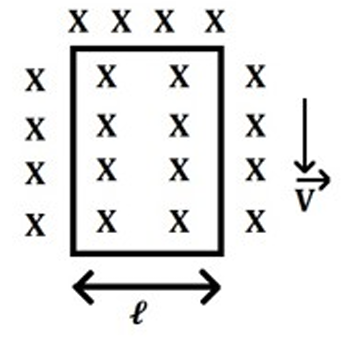
A long rectangular conducting loop of width ' $\ell$ ', mass ' m ' and resistance ' R ' is placed partly in a perpendicular magnetic field ' B '. It is pushed downwards with velocity ' $V$ ' so that it may continue to fall freely. The velocity ' $V$ ' is
- A$\frac{\mathrm{mg} \mathrm{R}^2}{\mathrm{~B} \ell}$
- B$\frac{\mathrm{B}^2 \ell^2 \mathrm{R}}{\mathrm{mg}}$
- Correct answerC$\frac{\mathrm{mg} \mathrm{R}}{\mathrm{B}^2 \ell^2}$
- D$\frac{\mathrm{mg} \ell}{\mathrm{B}^2 \mathrm{R}^2}$
Solution
The velocity $V$ at which the loop falls freely is determined by the terminal velocity condition where the magnetic force balances the gravitational force.
The induced electromotive force due to the motion in the magnetic field $B$ is $e = B \ell V$.
Using Ohm’s law, the induced current becomes $I = \frac{e}{R} = \frac{B \ell V}{R}$.
The resulting upward magnetic force is $F_m = B I \ell = \frac{B^2 \ell^2 V}{R}$.
Setting this equal to the gravitational force $mg$ gives $\frac{B^2 \ell^2 V}{R} = mg$.
Solving for $V$ yields $V = \frac{mgR}{B^2 \ell^2}$.
Among the options, this corresponds to choice C.
Hence, the correct answer is option: 'C'.