Q18 / 75 · JEE Main 2026 (22 January Shift 1) · Chemistry
' A ' is a neutral organic compound ($\mathrm{M}. \mathrm{F}: \mathrm{C}_{8} \mathrm{H}_{9} \mathrm{ON}$). On treatment with aqueous $\mathrm{Br}_{2} / \mathrm{HO}^{(-)}$, ' A ' forms a compound ' B ' which is soluble in dilute acid. ' B ' on treatment with aqueous $\mathrm{NaNO}_{2} / \mathrm{HCl}\left(0-5^{\circ} \mathrm{C}\right)$ produces a compound ' C ' which on treatment with $\mathrm{CuCN} / \mathrm{NaCN}$ produces ' D '. Hydrolysis of ' D ' produces ' E ' which is also obtainable from the hydrolysis of ' A '. ' E ' on treatment with acidified $\mathrm{KMnO}_{4}$ produces ' $F$ '. ' $F$ ' contains two different types of hydrogen atoms. The structure of ' A ' is
- A
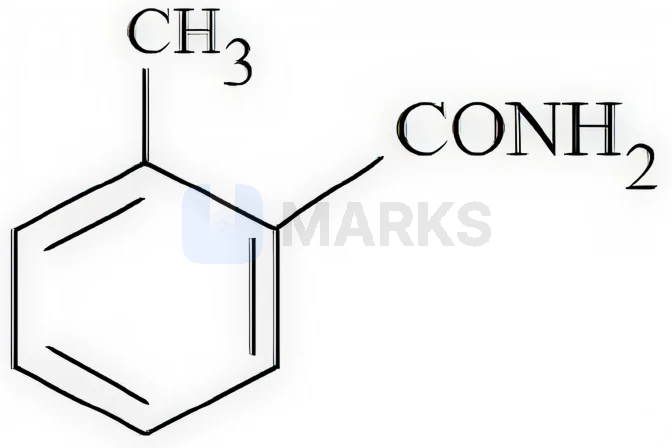
- B
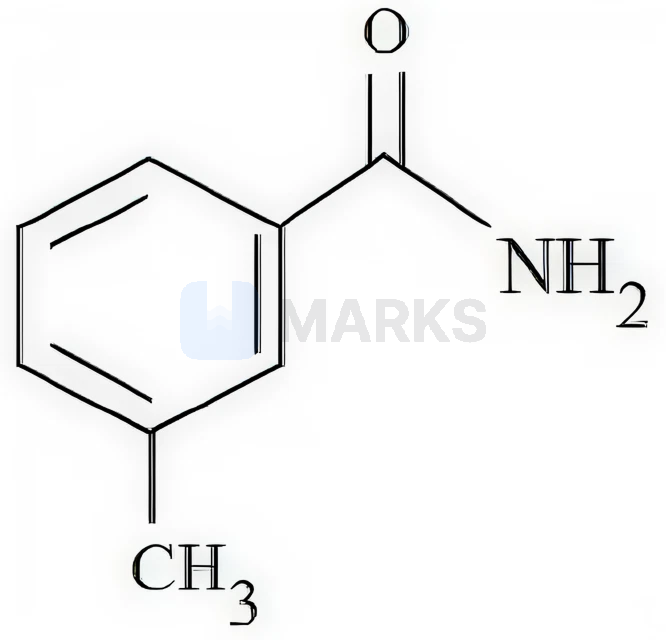
- Correct answerC
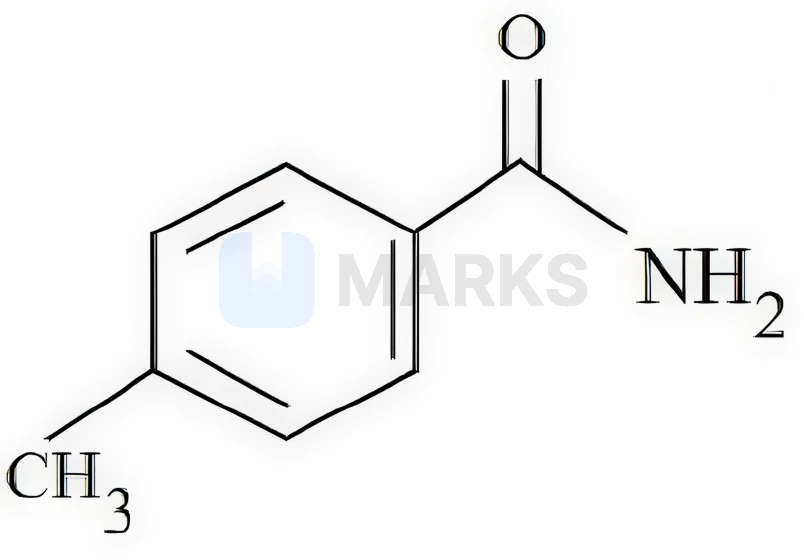
- D
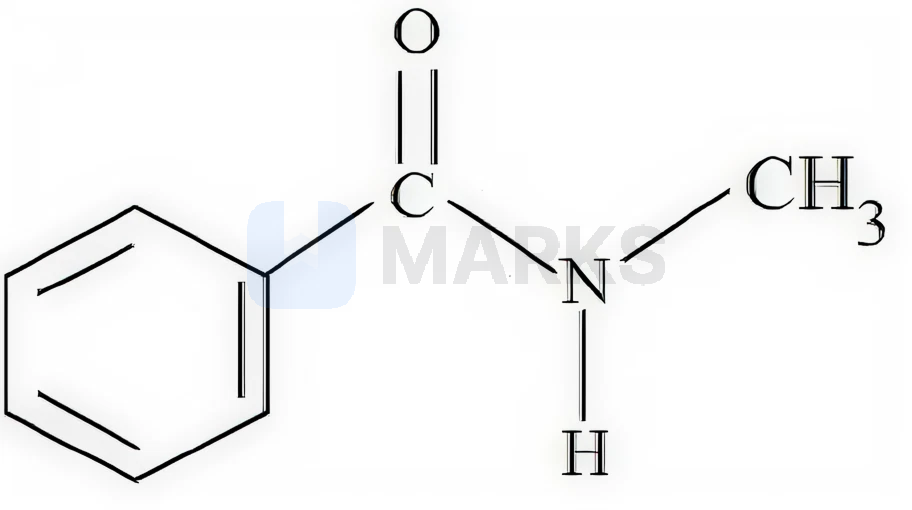
Solution
Compound A undergoes bromination with aqueous Br₂/HO⁻ to form B, which is soluble in dilute acid, indicating an amino group is present.
B undergoes diazotization with NaNO₂/HCl at 0-5°C to form diazonium compound C.
The diazonium compound is then treated with CaCN/NaOH to form nitrile compound D.
Hydrolysis of D produces carboxylic acid E.
When A is treated with acidified KMnO₄, it produces F containing two different types of hydrogen atoms.
This reaction sequence is characteristic of anthranilic acid (2-aminobenzoic acid), where the amino group directs bromination to the para position, and subsequent reactions proceed through the diazonium intermediate.
The structure shown in option (3), which is 2-aminobenzoic acid, fits all these transformations.
Hence, the correct answer is option: 'C'.