Q136 / 160 · TS EAMCET 2020 (14 Sep Shift 2) · Physics
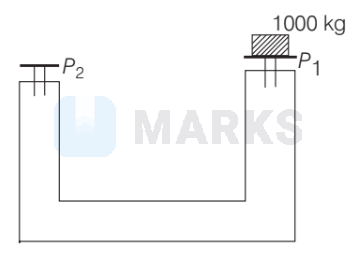
A hydraulic lift as shown in the figure is used to lift a mass of $1000 \mathrm{~kg}$, which is placed on a piston $\left(P_1\right)$ of area $1 \mathrm{~m}^2$. If the cross-section area of the piston $\left(P_2\right)$ at the other end is $0.01 \mathrm{~m}^2$, then how much mass needs to be put on it to lift the $1000 \mathrm{~kg}$ ?
- A1 kg
- Correct answerB10 kg
- C50 kg
- D100 kg
Solution
According to Pascal's law,
$P_1=P_2$
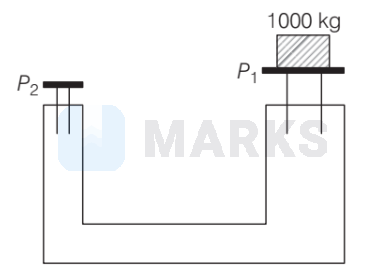
$\begin{array}{lll}\Rightarrow & \frac{F_1}{A_1}=\frac{F_2}{A_2} \\ \Rightarrow & \frac{1000 g}{1}=\frac{m_2 g}{0.01} \quad\left[\because A_1=\mathrm{lm}^2, A_2=0.0 \mathrm{~lm}^2\right] \\ \Rightarrow & m_2=1000 \times 0.01=10 \mathrm{~kg}\end{array}$
$\begin{array}{lll}\Rightarrow & \frac{F_1}{A_1}=\frac{F_2}{A_2} \\ \Rightarrow & \frac{1000 g}{1}=\frac{m_2 g}{0.01} \quad\left[\because A_1=\mathrm{lm}^2, A_2=0.0 \mathrm{~lm}^2\right] \\ \Rightarrow & m_2=1000 \times 0.01=10 \mathrm{~kg}\end{array}$
Hence, the correct answer is option: 'B'.