Q127 / 180 · NEET 2026 (Re-NEET) · Physics
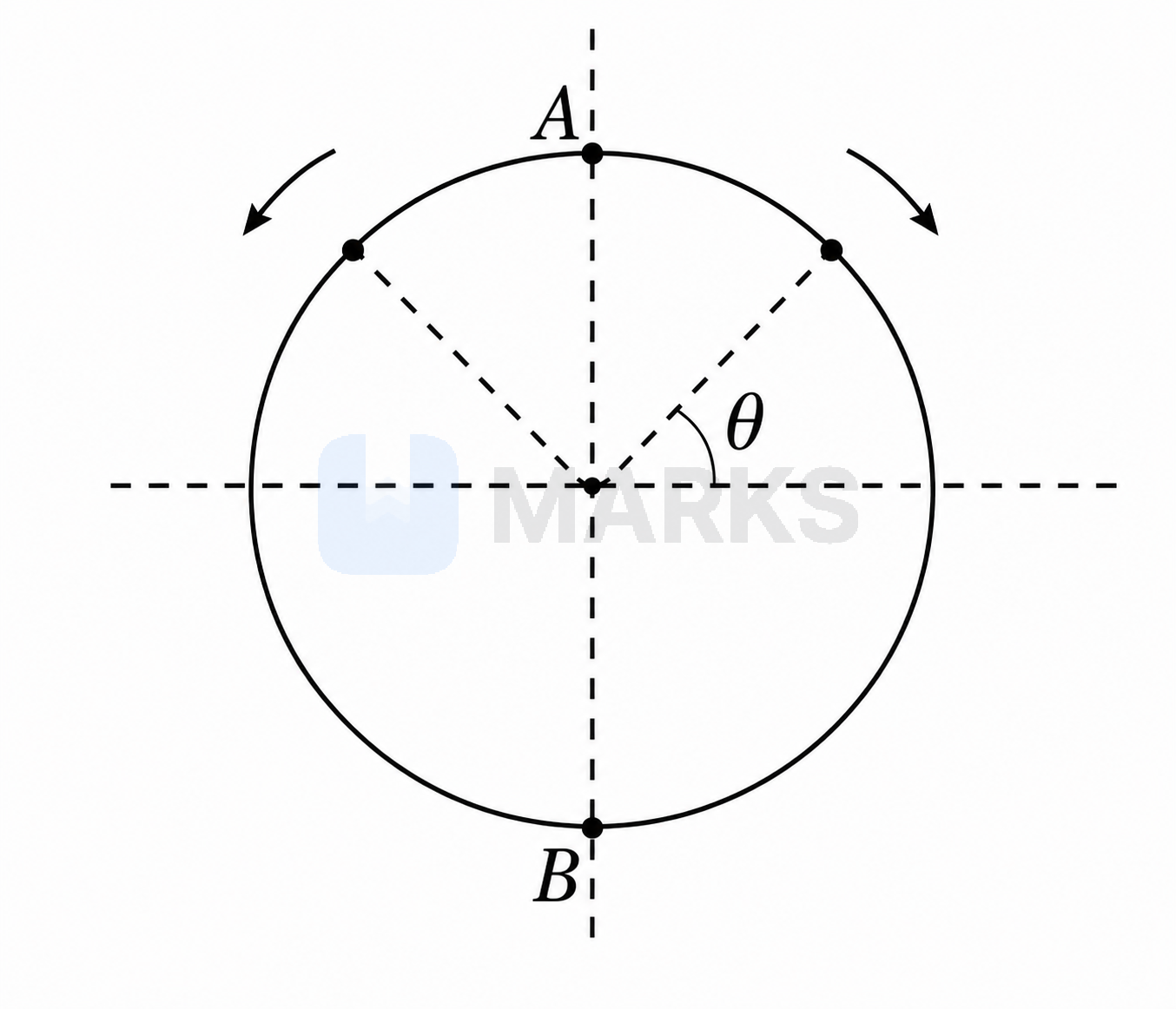
A frictionless circular wire of unit radius is fixed on the horizontal plane. Two point particles of unit mass start moving simultaneously from point $A\left(\theta=\dfrac{\pi}{2}\right)$ with identical uniform angular speeds in opposite directions, and meet again at point $B\left(\theta=-\dfrac{\pi}{2}\right)$. During this time, which of the following figures schematically represent the magnitude of the total linear momentum $P$ of the system, as a function of $\theta$ ?
- A
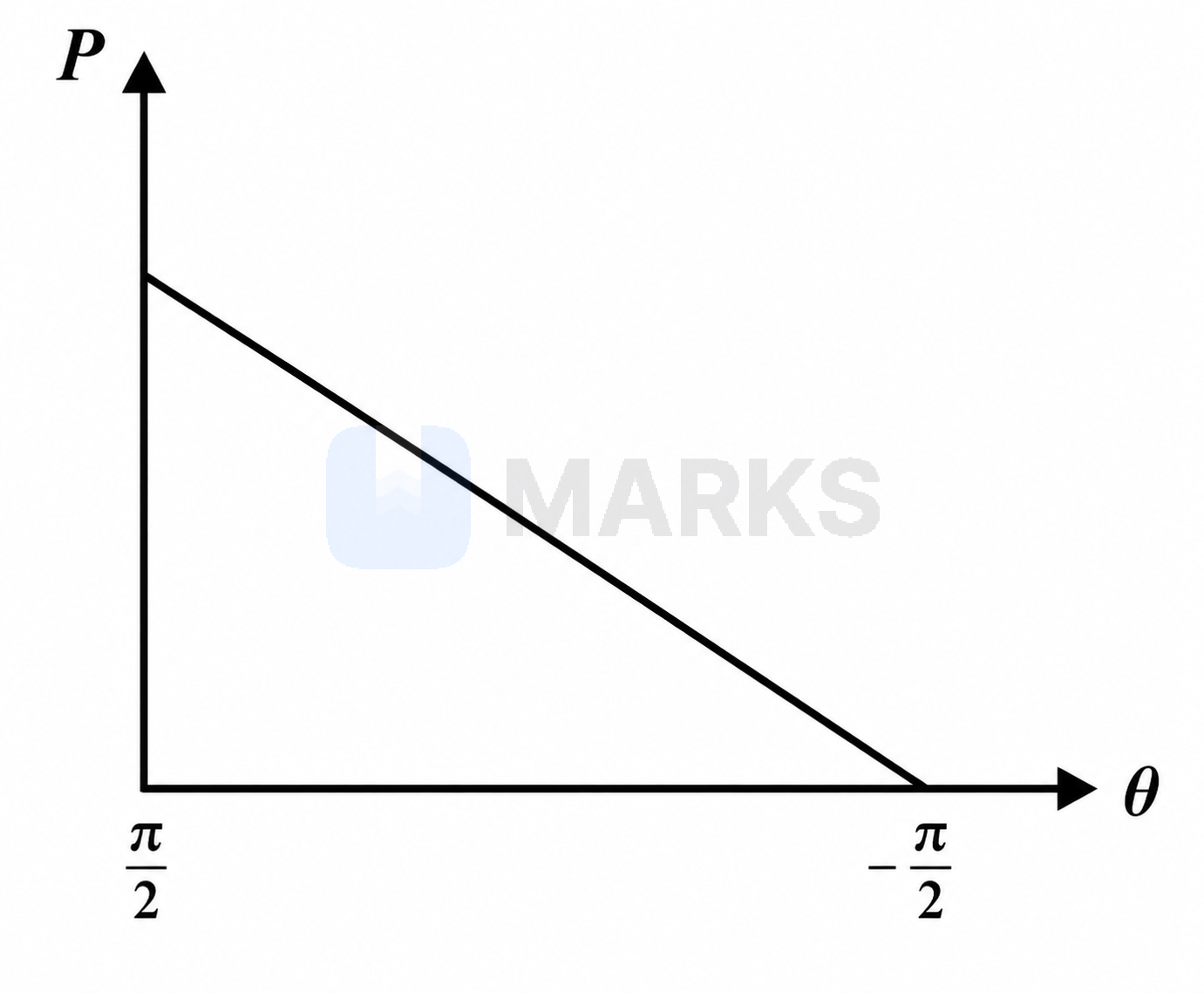
- B
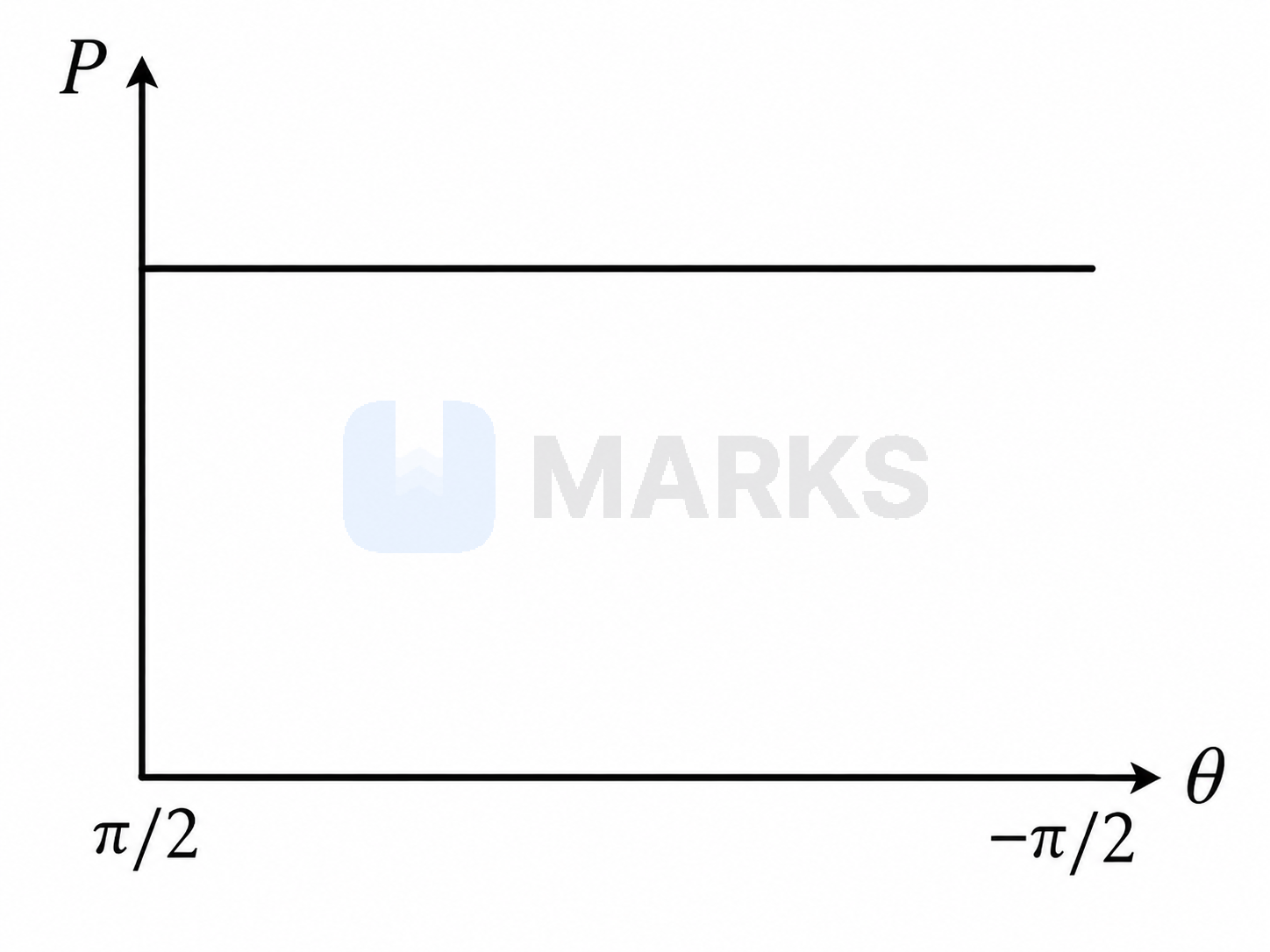
- C
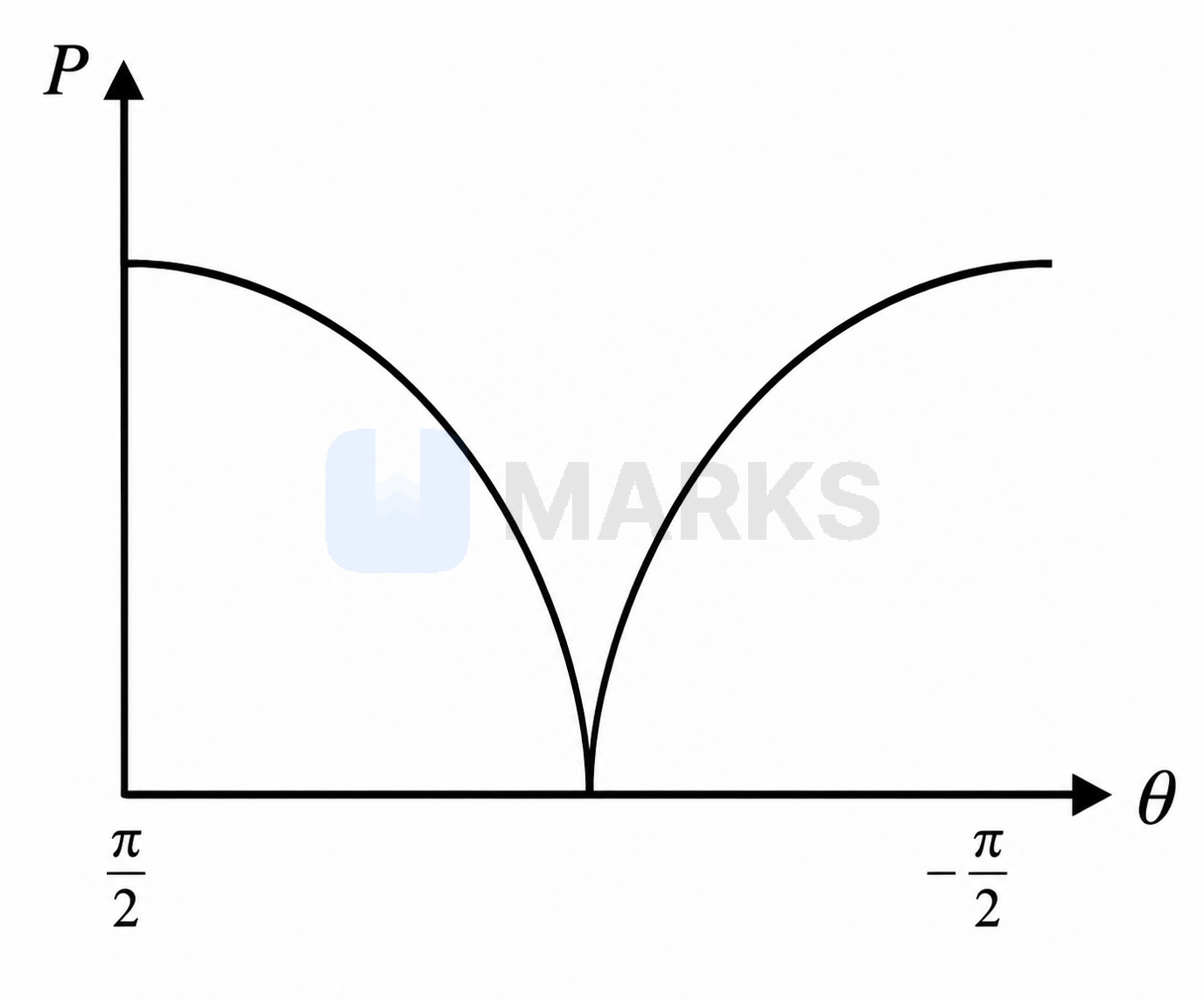
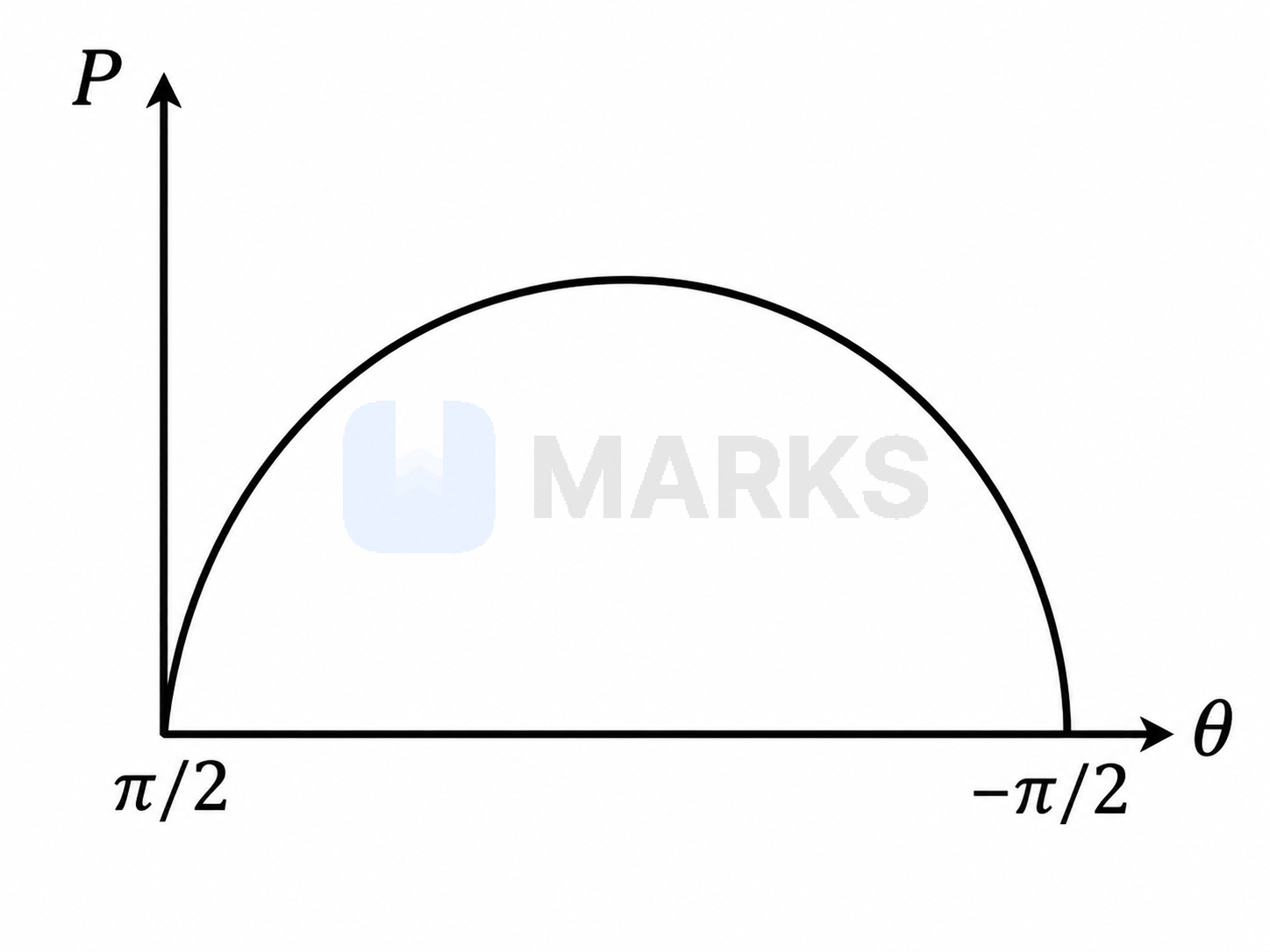
- Correct answerD
Solution
Let the uniform angular speed of the particles be $\omega$.
The position vector of the particle on the right at an angle $\theta$ is given by $\vec{r}_1 = \cos\theta \hat{i} + \sin\theta \hat{j}$.
Since it moves from $\theta = \dfrac{\pi}{2}$ to $\theta = -\dfrac{\pi}{2}$, its angular velocity is $\dfrac{d\theta}{dt} = -\omega$.
The velocity of the first particle is $\vec{v}_1 = \dfrac{d\vec{r}_1}{dt} = (-\sin\theta \hat{i} + \cos\theta \hat{j})\dfrac{d\theta}{dt} = \omega\sin\theta \hat{i} - \omega\cos\theta \hat{j}$.
By symmetry, the position vector of the particle on the left is $\vec{r}_2 = -\cos\theta \hat{i} + \sin\theta \hat{j}$.
Its velocity is $\vec{v}_2 = \dfrac{d\vec{r}_2}{dt} = (\sin\theta \hat{i} + \cos\theta \hat{j})\dfrac{d\theta}{dt} = -\omega\sin\theta \hat{i} - \omega\cos\theta \hat{j}$.
The total linear momentum of the system is $\vec{P} = m\vec{v}_1 + m\vec{v}_2$.
Given $m = 1$, we have $\vec{P} = (\omega\sin\theta \hat{i} - \omega\cos\theta \hat{j}) + (-\omega\sin\theta \hat{i} - \omega\cos\theta \hat{j}) = -2\omega\cos\theta \hat{j}$.
The magnitude of the total linear momentum is $P = |\vec{P}| = 2\omega\cos\theta$ (since $\cos\theta \geq 0$ for $\theta \in \left[-\dfrac{\pi}{2}, \dfrac{\pi}{2}\right]$).
The graph of $P$ versus $\theta$ is a cosine curve which is zero at $\theta = \pm\dfrac{\pi}{2}$ and maximum at $\theta = 0$. This corresponds to the fourth graph.
Answer:
Hence, the correct answer is option: 'D'.