Q46 / 180 · AIIMS 2019 (25 May) · Chemistry
Which one of the following complexes shows optical isomerism?
- A$\left[\mathrm{Co}\left(\mathrm{NH}_3\right)_3 \mathrm{Cl}_3\right]$
- Correct answerBcis- $\left[\mathrm{Co}(e n)_2 \mathrm{Cl}_2\right] \mathrm{Cl}$
- Ctrans- $\left[\mathrm{Co}(e n)_2 \mathrm{Cl}_2\right] \mathrm{Cl}$
- D$\begin{aligned} & {\left[\mathrm{Co}\left(\mathrm{NH}_3\right)_4 \mathrm{Cl}_2\right] \mathrm{Cl}} \\ & \text { (en= ethylenediamine) }\end{aligned}$
Solution
$\left[\mathrm{Co}\left(\mathrm{NH}_3\right)_3 \mathrm{Cl}_3\right]$ has two geometrical isomers but both are optically inactive due to plane of symmetry.
cis- $\left[\mathrm{Co}(e n)_2 \mathrm{Cl}_2\right] \mathrm{Cl}$ is optically active.
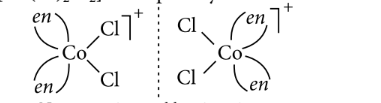
Non -superimposable mirror images trans- $\left[\mathrm{Co}(e n)_2 \mathrm{Cl}_2\right] \mathrm{Cl}$ is optically inactive due to plane of symmetry. $\left[\mathrm{Co}\left(\mathrm{NH}_3\right)_4 \mathrm{Cl}_2\right] \mathrm{Cl}$ has two geometrical isomers but both are optically inactive due to plane of symmetry.
Non -superimposable mirror images trans- $\left[\mathrm{Co}(e n)_2 \mathrm{Cl}_2\right] \mathrm{Cl}$ is optically inactive due to plane of symmetry. $\left[\mathrm{Co}\left(\mathrm{NH}_3\right)_4 \mathrm{Cl}_2\right] \mathrm{Cl}$ has two geometrical isomers but both are optically inactive due to plane of symmetry.
Hence, the correct answer is option: 'B'.