Q53 / 180 · COMEDK 2024 (Afternoon Shift) · Chemistry
Which of the following reactions is an example for incomplete combustion?
- A

- B
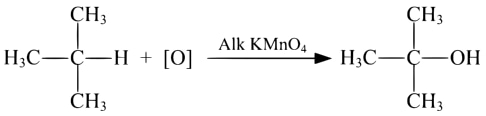
- C

- Correct answerD

Solution
Complete combustion of a hydrocarbon involves the reaction of the fuel with sufficient oxygen to produce carbon dioxide and water as the only products. Incomplete combustion occurs when there is insufficient oxygen, leading to the formation of products like carbon monoxide or elemental carbon (soot) instead of carbon dioxide.
Analyzing the given reactions:
1. The first reaction is $\text{C}_{4}\text{H}_{10} + \dfrac{13}{2}\text{O}_{2} \rightarrow 4\text{CO}_{2} + 5\text{H}_{2}\text{O}$. This is complete combustion of butane.
2. The second reaction is the oxidation of isobutane to tert-butyl alcohol using alkaline $\text{KMnO}_{4}$, which is a controlled oxidation, not combustion.
3. The third reaction is the controlled catalytic oxidation of methane to formaldehyde ($\text{HCHO}$), not combustion.
4. The fourth reaction is $\text{CH}_{4} + \text{O}_{2} \rightarrow \text{C(s)} + 2\text{H}_{2}\text{O(l)}$. Here, carbon is produced in the form of soot (solid carbon) instead of carbon dioxide, which is a characteristic feature of incomplete combustion of methane.
Answer:
Hence, the correct answer is option: 'D'.