Q63 / 200 · NEET 2004 · Chemistry
Which of the following is least reactive in a nucleophilic substitution reaction?
- A$\left(\mathrm{CH}_3\right)_3 \mathrm{C}-\mathrm{Cl}$
- Correct answerB$\mathrm{CH}_2=\mathrm{CHCl}$
- C$\mathrm{CH}_3 \mathrm{CH}_2 \mathrm{CL}$
- D$\mathrm{CH}_2=\mathrm{CHCH}_2 \mathrm{Cl}$
Solution
Chlorine of vinyl chloride $\left(\mathrm{CH}_2=\right.$ $\mathrm{CHCl}$ ) is non-reactive (less reactive) towards nucleophile in nucleophilic substitution reaction because it shows resonance due to $+\mathrm{M}$ effect of $-\mathrm{Cl}$ atom.
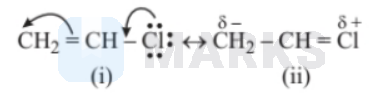
In structure II, Cl-atom have positive charge and partial double bond character with $\mathrm{C}$ of vinyl group, so it is more tightly attracted towards the nucleus and it does not get replaced by nucleophile in $\mathrm{S}_{\mathrm{N}}$ reaction. Related Theory $s p^3$-hybridized electrophile must have a leaving group $(\mathrm{X})$ in order for the reaction to take place.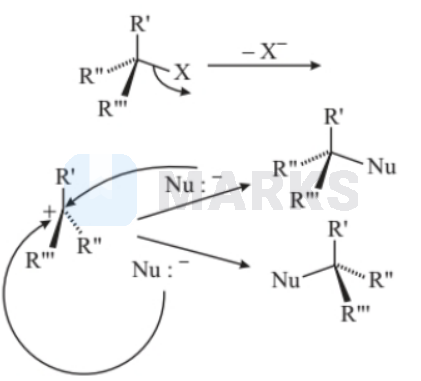
In structure II, Cl-atom have positive charge and partial double bond character with $\mathrm{C}$ of vinyl group, so it is more tightly attracted towards the nucleus and it does not get replaced by nucleophile in $\mathrm{S}_{\mathrm{N}}$ reaction. Related Theory $s p^3$-hybridized electrophile must have a leaving group $(\mathrm{X})$ in order for the reaction to take place.
Hence, the correct answer is option: 'B'.