Q7 / 180 · KCET 2008 · Chemistry
Which of the following has the maximum number of unpaired ' $d$ ' electrons?
- A$\mathrm{Zn}^{2+}$
- Correct answerB$\mathrm{Fe}^{2+}$
- C$\mathrm{Ni}^{3+}$
- D$\mathrm{Cu}^{+}$
Solution
$$
\begin{aligned}
\mathrm{Zn}(30)=& {[\mathrm{Ar}] 3 \mathrm{~d}^{10}, 4 \mathrm{~s}^{2} } \\
\mathrm{Zn}^{2+} &=[\mathrm{Ar}] 3 \mathrm{~d}^{10} \text { (no unpaired electron) } \\
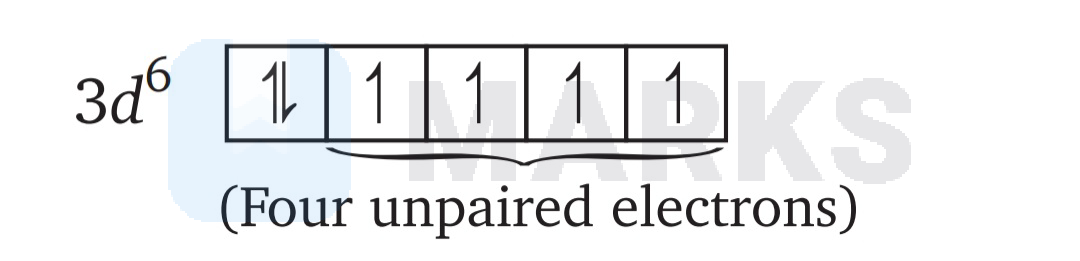
\mathrm{Fe}(26) &=[\mathrm{Ar}] 3 \mathrm{~d}^{6}, 4 \mathrm{~s}^{2} \\
\mathrm{Fe}^{2+} &=[\mathrm{Ar}] 3 \mathrm{~d}^{6} \text { (four unpaired electrons) }
\end{aligned}
$$
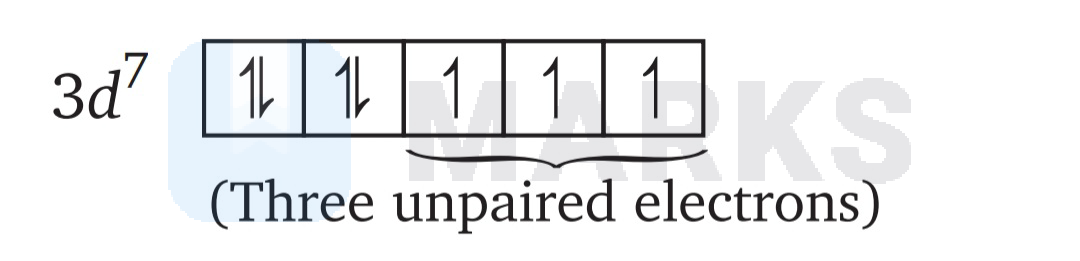
$\begin{aligned} \mathrm{Ni}(28) &=[\mathrm{Ar}] 3 \mathrm{~d}^{8}, 4 \mathrm{~s}^{2} \\ \mathrm{Ni}^{3+} &=[\mathrm{Ar}] 3 \mathrm{~d}^{7} \text { (three unpaired electrons) } \end{aligned}$
$$ \begin{aligned} \mathrm{Cu}(29) &=[\mathrm{Ar}] 3 \mathrm{~d}^{10}, 4 \mathrm{~s}^{1} \\ \mathrm{Cu}^{+} &=[\mathrm{Ar}] 3 \mathrm{~d}^{10} \text { (no unpaired electron) } \end{aligned} $$
$\begin{aligned} \mathrm{Ni}(28) &=[\mathrm{Ar}] 3 \mathrm{~d}^{8}, 4 \mathrm{~s}^{2} \\ \mathrm{Ni}^{3+} &=[\mathrm{Ar}] 3 \mathrm{~d}^{7} \text { (three unpaired electrons) } \end{aligned}$
$$ \begin{aligned} \mathrm{Cu}(29) &=[\mathrm{Ar}] 3 \mathrm{~d}^{10}, 4 \mathrm{~s}^{1} \\ \mathrm{Cu}^{+} &=[\mathrm{Ar}] 3 \mathrm{~d}^{10} \text { (no unpaired electron) } \end{aligned} $$
Hence, the correct answer is option: 'B'.