Q12 / 180 · COMEDK 2022 · Chemistry
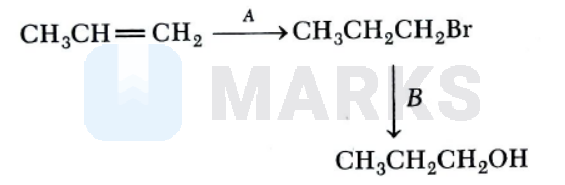
What can be $A$ and $B$ in the following reaction?
- AA. $\mathrm{HBr}$ B. alc. $\mathrm{KOH}$
- BA. $\mathrm{HBr}$, Peroxide B. alc. $\mathrm{KOH}$
- Correct answerCA. $\mathrm{HBr}$, Peroxide B. aq. $\mathrm{KOH}, \Delta$
- DA. $\mathrm{HBr}$, B. $a q . \mathrm{KOH}, \Delta$
Solution
The conversion of propene ($\text{CH}_{3}\text{CH}=\text{CH}_{2}$) to 1-bromopropane ($\text{CH}_{3}\text{CH}_{2}\text{CH}_{2}\text{Br}$) is an anti-Markovnikov addition of HBr. This reaction occurs in the presence of organic peroxides (Kharasch effect or peroxide effect). Thus, reagent A is $\text{HBr}$ with peroxide.
The conversion of 1-bromopropane ($\text{CH}_{3}\text{CH}_{2}\text{CH}_{2}\text{Br}$) to propan-1-ol ($\text{CH}_{3}\text{CH}_{2}\text{CH}_{2}\text{OH}$) is a nucleophilic substitution reaction. Alkyl halides react with aqueous potassium hydroxide ($\text{aq. KOH}$) under heating to undergo hydrolysis, yielding the corresponding alcohol. Thus, reagent B is $\text{aq. KOH}, \Delta$.
Comparing these with the given options, reagent A is $\text{HBr}$, Peroxide and reagent B is $\text{aq. KOH}, \Delta$.
Answer: A. $\mathrm{HBr}$, Peroxide $\quad$ B. aq. $\mathrm{KOH}, \Delta$
Hence, the correct answer is option: 'C'.