Q23 / 56 · IAT (IISER) 2026 · Chemistry
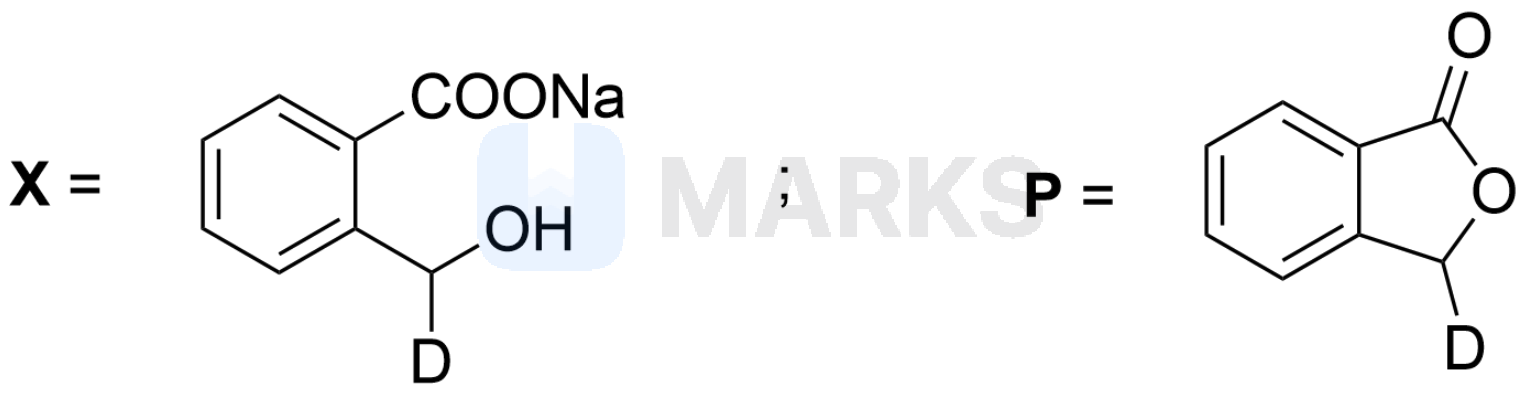
What are X and P in the following reaction sequence?
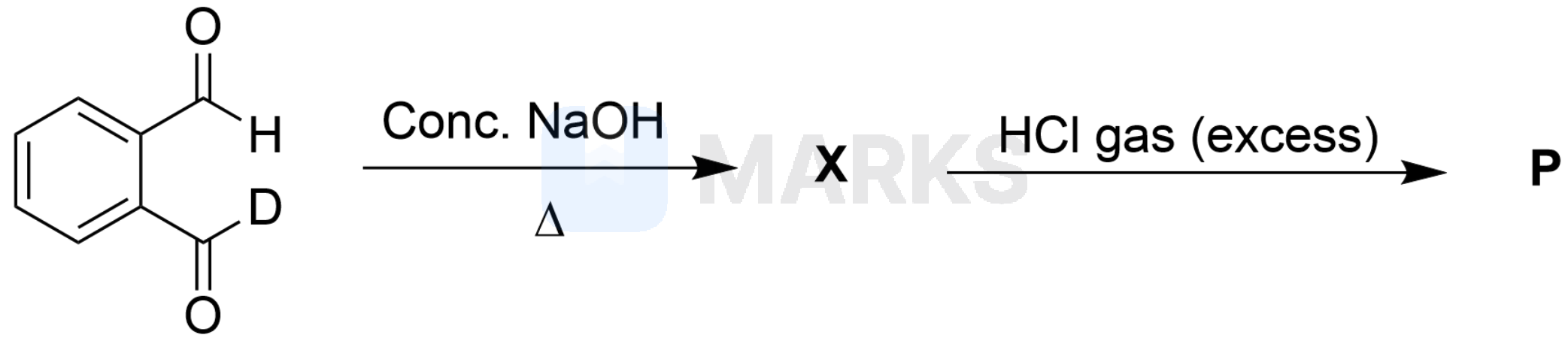
- A
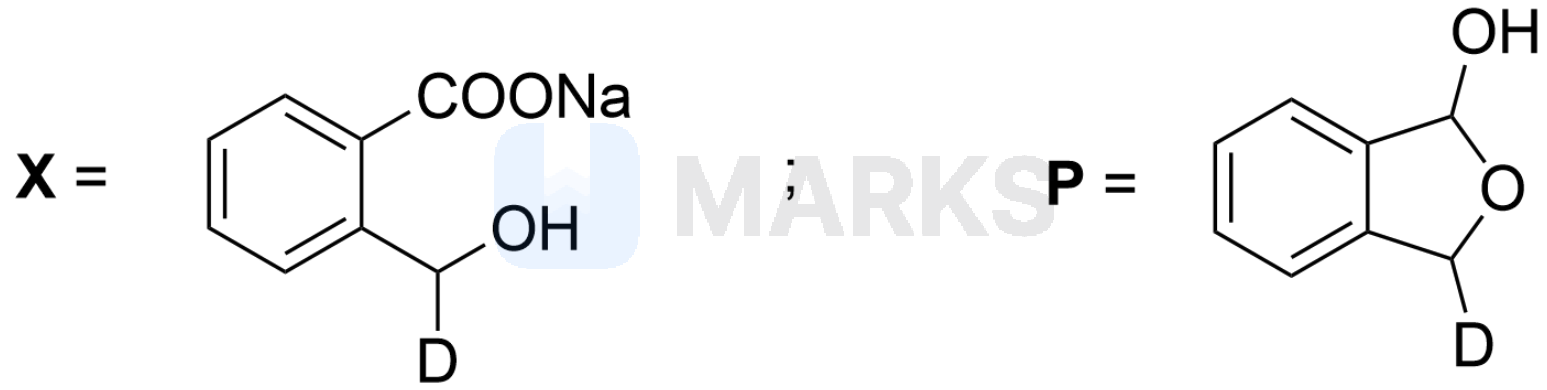
- B
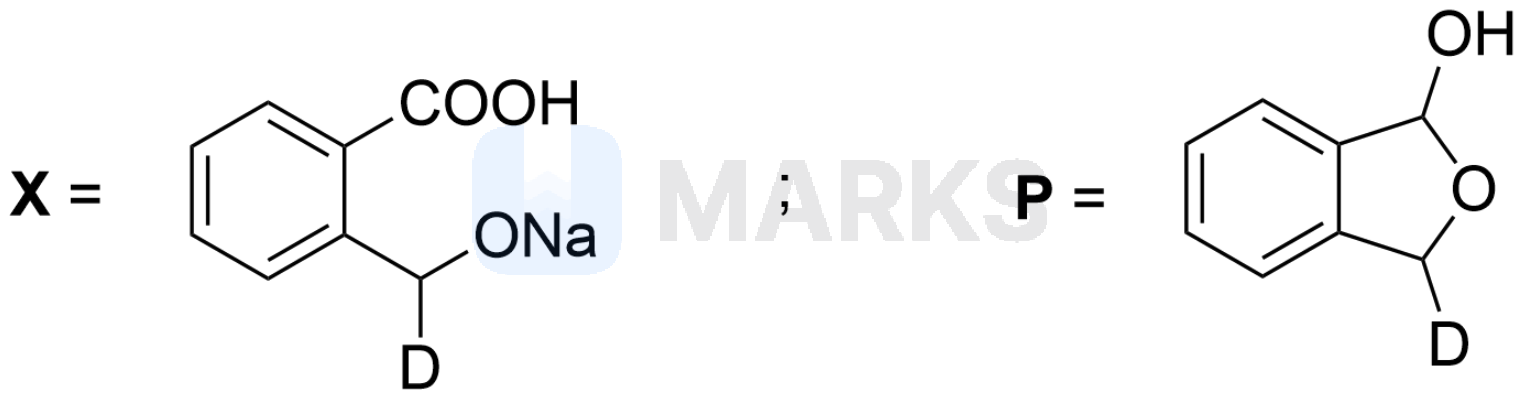
- C
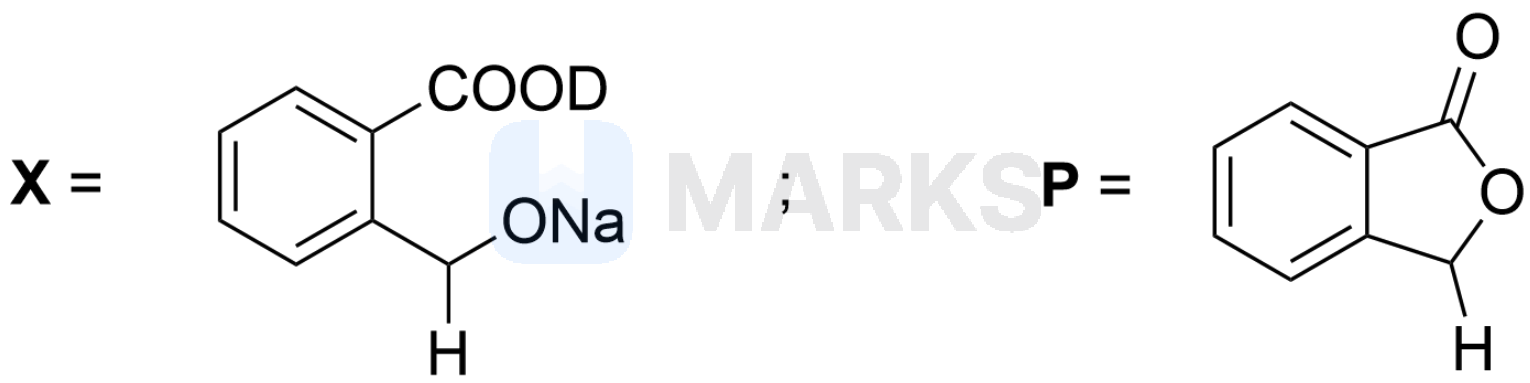
- Correct answerD
Solution
The given reaction is an intramolecular Cannizzaro reaction of a dialdehyde having $-CHO$ and $-CDO$ groups.
In the first step, the hydroxide ion ($OH^-$) attacks the carbonyl carbon. The $-CHO$ carbon is slightly more electrophilic than the $-CDO$ carbon due to the +I effect of deuterium. More importantly, in the rate-determining step, the transfer of a hydride ion ($H^-$) is faster than the transfer of a deuteride ion ($D^-$) due to the primary kinetic isotope effect ($k_H > k_D$).
Therefore, the $OH^-$ attacks the $-CHO$ group, forming an intermediate that transfers a hydride ion to the $-CDO$ group. As a result, the $-CHO$ group is oxidized to a carboxylic acid (which forms the carboxylate salt in basic medium), and the $-CDO$ group is reduced to an alcohol.
The intermediate product X is sodium 2-(hydroxymethyl-d1)benzoate, where the original $-CHO$ group becomes a $-COONa$ group and the original $-CDO$ group becomes a $-CH(D)OH$ group.
In the second step, treatment of X with excess HCl gas protonates the carboxylate salt to form 2-(hydroxymethyl-d1)benzoic acid. Under these acidic conditions, the molecule undergoes intramolecular esterification (lactonization), eliminating a molecule of water to form a stable five-membered lactone ring.
The final product P is a phthalide derivative, which features a carbonyl group in the lactone ring and a deuterium atom on the $sp^3$ carbon.
Answer:
Hence, the correct answer is option: 'D'.