Q20 / 180 · COMEDK 2025 (10 May Shift 3) · Chemistry
What are the intermediates formed during the reactions A and B ?
A. Reimer-Tiemann reaction.
B. Dehydration of alcohols in the slow rate determining step.
- A
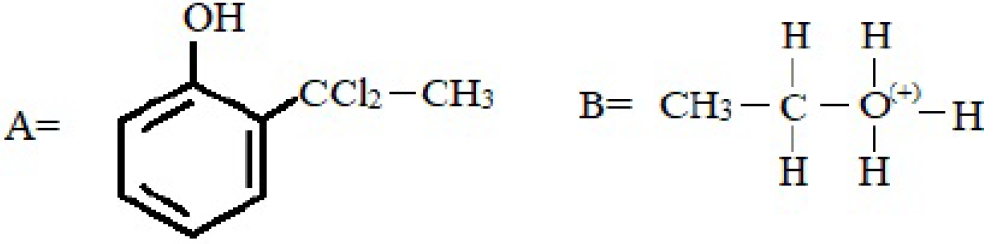
- B
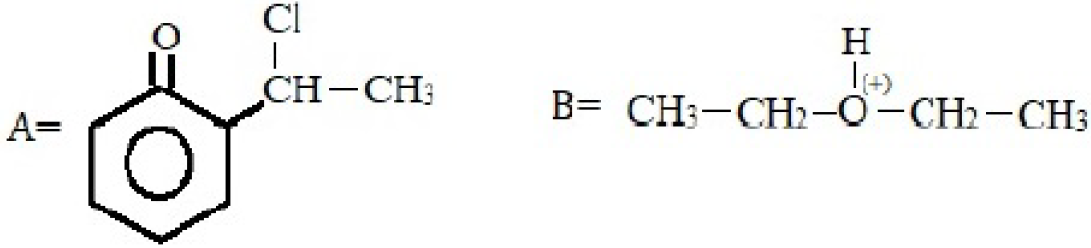
- C
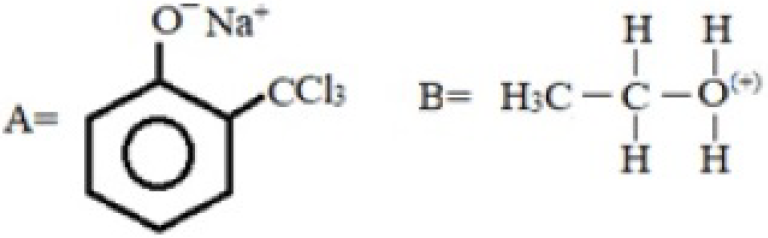
- Correct answerD
Solution
A. Reimer-Tiemann Reaction:
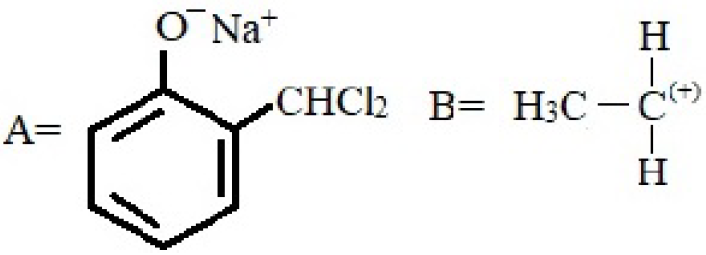
Phenol is treated with $CHCl_3$ and $NaOH$. The base generates dichlorocarbene $(:CCl_2)$, which attacks the ortho position of the phenoxide ion. The intermediate is sodium 2-(dichloromethyl)phenolate — a phenoxide ring with an ortho $-CHCl_2$ group (option 4, structure A).
B. Dehydration of Alcohols (slow step):
In acid-catalyzed E1 dehydration, the slow rate-determining step is the breaking of the C$-$O bond after protonation of $-OH$, forming a carbocation $R^+$. The intermediate is the carbocation $H_3C-\overset{(+)}{C}-H$ (option 4, structure B).
Option (4) is correct.
Hence, the correct answer is option: 'D'.