Q165 / 200 · MHT CET - Medical 2026 (24 April Shift 2) · Physics
Water flows through a horizontal tube as shown. If the difference of heights of water column in the vertical tubes is $h = 2\ \text{cm}$, and the areas of cross section at A and B are $4\ \text{cm}^2$ and $2\ \text{cm}^2$ respectively, the difference in pressure that is $(P_A - P_B)$ is $\{v_A = $ velocity of water at point A, $v_B = $ velocity of water at point B$\}$
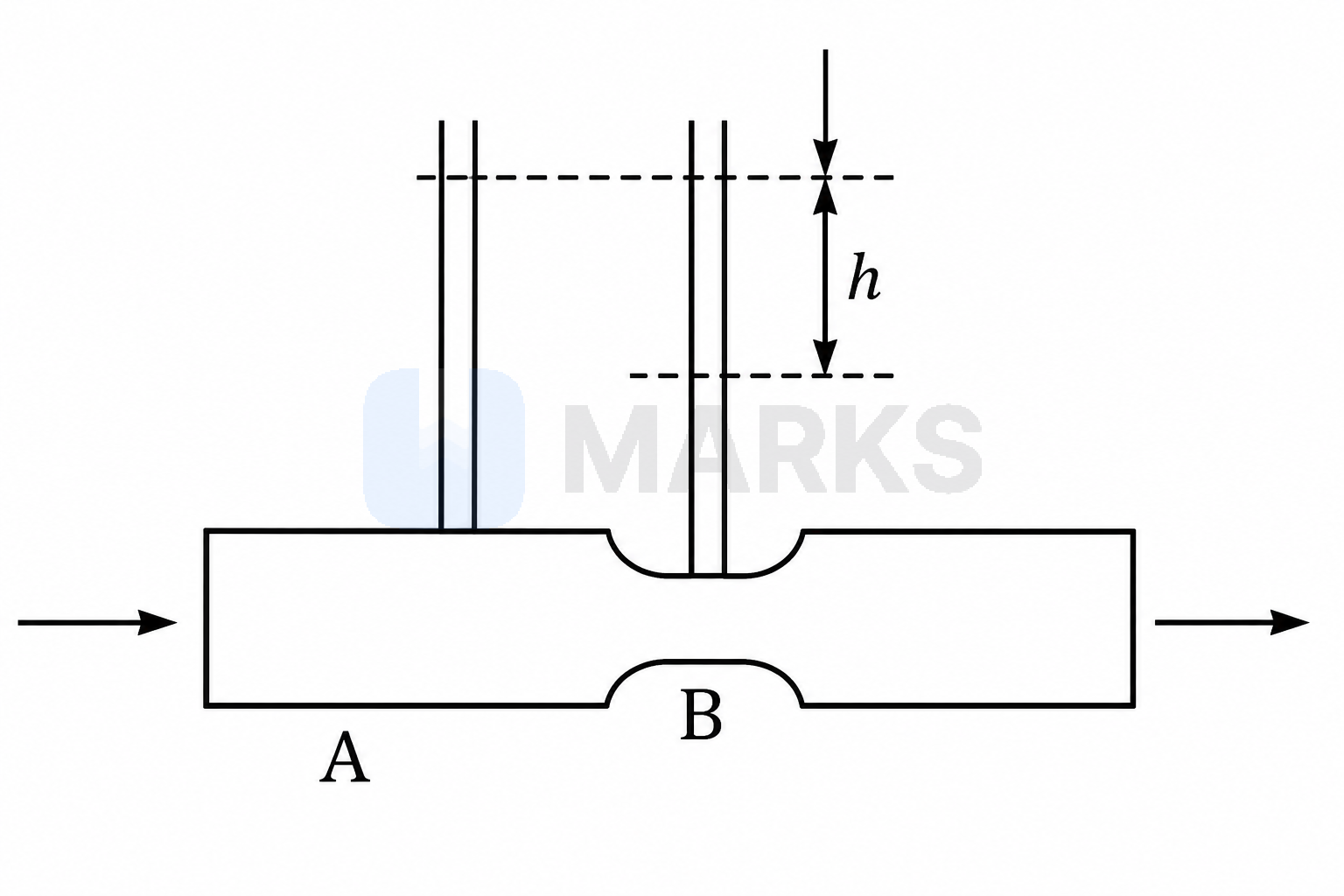
- Correct answerA$\dfrac{3}{2}v_A^2$
- B$\dfrac{1}{2}v_A^2$
- C$v_A^2$
- D$2v_A^2$
Solution
From the equation of continuity:
$A_A v_A = A_B v_B$
Given $A_A = 4 \text{ cm}^2$ and $A_B = 2 \text{ cm}^2$:
$4 v_A = 2 v_B \Rightarrow v_B = 2 v_A$
Using Bernoulli's equation for a horizontal tube:
$P_A + \dfrac{1}{2}\rho v_A^2 = P_B + \dfrac{1}{2}\rho v_B^2$
$\Rightarrow P_A - P_B = \dfrac{1}{2}\rho (v_B^2 - v_A^2)$
Substituting $v_B = 2 v_A$:
$P_A - P_B = \dfrac{1}{2}\rho ((2v_A)^2 - v_A^2) = \dfrac{3}{2}\rho v_A^2$
Taking the density of water in CGS units as $\rho = 1 \text{ g/cm}^3$, the pressure difference is:
$P_A - P_B = \dfrac{3}{2}v_A^2$
Answer: $\dfrac{3}{2}v_A^2$
Hence, the correct answer is option: 'A'.