Q6 / 180 · COMEDK 2022 · Chemistry
$\text { } X \text { and } Y \text { in the following reactions are }$

- A
- B
- Correct answerC
- D
Solution
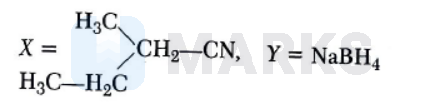
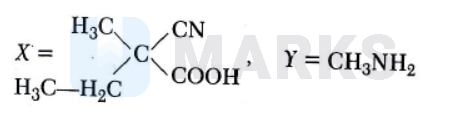
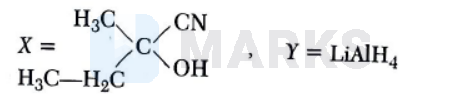
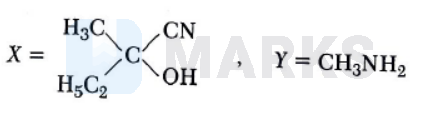
The reaction of butan-2-one ($CH_{3}COCH_{2}CH_{3}$) with $HCN$ in the presence of $KCN$ is a nucleophilic addition reaction, which forms a cyanohydrin. The product $X$ is 2-hydroxy-2-methylbutanenitrile, represented as $CH_{3}C(OH)(CN)CH_{2}CH_{3}$.
The conversion of the cyanohydrin $X$ to the final product, which is 1-amino-2-methylbutan-2-ol ($CH_{3}C(OH)(CH_{2}NH_{2})CH_{2}CH_{3}$), involves the reduction of the nitrile group ($-CN$) to a primary amine group ($-CH_{2}NH_{2}$).
Lithium aluminium hydride ($LiAlH_{4}$) is a strong reducing agent capable of reducing both the nitrile group and other functional groups, but in this specific transformation, it effectively reduces the $-CN$ group to $-CH_{2}NH_{2}$ while leaving the tertiary alcohol group intact. Therefore, $Y$ is $LiAlH_{4}$.
Comparing this with the given options, the third option correctly identifies $X$ as the cyanohydrin and $Y$ as $LiAlH_{4}$.
Answer:
Hence, the correct answer is option: 'C'.