Q12 / 60 · NEST (NISER) 2016 · Biology
Two unique reptilian species (P and Q) reproduce in ambient temperature range $\left(31^{\circ} \mathrm{C}\right.$ to $35^{\circ} \mathrm{C}$ only). A group of scientists found a strange observation regarding the "male to female ratio" as obtained from fertilized eggs artificially hatched within laboratory incubators, as shown in the figure below.
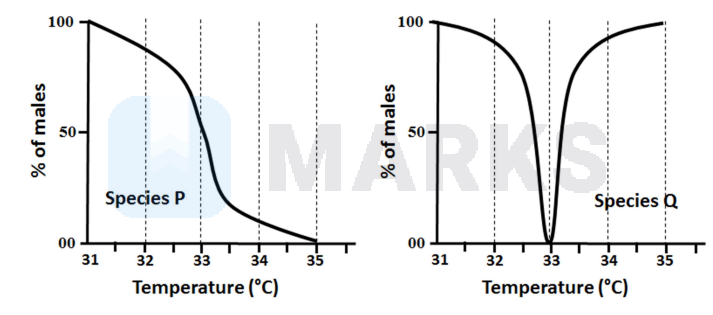
The maximum life span of these reptiles is 5 years. 50 male and 50 female adults each of species P and Q were used to start a 10 year long study. The eggs were always hatched in incubators during this study. In the absence of any other factors, which of the following possible outcome(s) is/are correct?
The maximum life span of these reptiles is 5 years. 50 male and 50 female adults each of species P and Q were used to start a 10 year long study. The eggs were always hatched in incubators during this study. In the absence of any other factors, which of the following possible outcome(s) is/are correct?
- Correct answerAIf the temperature of the incubator is strictly maintained at $33^{\circ} \mathrm{C}$ for 10 consecutive years, the species P is expected to have more males than in species Q.
- BIf the temperature of the incubator is strictly maintained at $31^{\circ} \mathrm{C}$ for 10 consecutive years, there will be more males in species P than in species Q .
- Correct answerCIf the temperature of the incubator is strictly maintained at $31^{\circ} \mathrm{C}$ for 10 consecutive years, then both P and Q will not survive in the lab.
- Correct answerDIf the temperature of the incubator is strictly maintained at $31^{\circ} \mathrm{C}$ and $35^{\circ} \mathrm{C}$ for every alternate year (for a total of 10 years), there will be more males in species $P$ than species $Q$.
Hence, the correct answer is options: 'A', 'C', 'D'.