Q36 / 180 · COMEDK 2025 (10 May Shift 1) · Chemistry
Two statements, one Assertion (A) and the other Reason (R) are given. Choose the correct option.
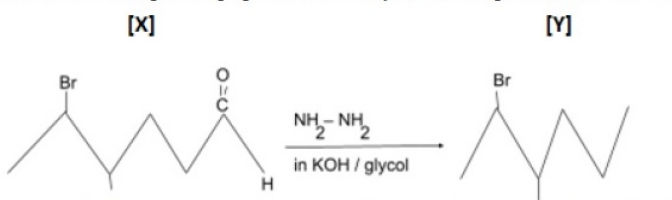
Assertion: Compound $[\mathrm{X}]$ reacts with Hydrazine in presence of $\mathrm{KOH} /$ Glycol to form the product $[\mathrm{Y}]$.
- Correct answerABoth A and R are correct and R is the correct explanation of A .
- BBoth $A$ and $R$ are correct but $R$ is not the correct explanation of $A$.
- CA is wrong but R is correct.
- D$A$ is correct but $R$ is wrong.
Solution
The reaction shown is the Wolff-Kishner reduction, which uses hydrazine ($NH_{2}NH_{2}$) in the presence of a strong base like $KOH$ and a high-boiling solvent like ethylene glycol to reduce a carbonyl group (aldehyde or ketone) to a methylene group ($-CH_{2}-$).
In the given reaction, the aldehyde group ($-CHO$) in compound [X] is reduced to a methyl group ($-CH_{3}$) to form compound [Y].
The Wolff-Kishner reduction is specifically designed to reduce carbonyl compounds to alkanes. It does not affect other functional groups like alkyl halides under standard conditions, although strong bases like $KOH$ can potentially cause elimination reactions in alkyl halides. However, in the context of this transformation, the conversion of the aldehyde to the methyl group is the primary intended reaction.
Since the assertion correctly describes the transformation of [X] to [Y] using the Wolff-Kishner reduction conditions, and the reaction is indeed a standard application of this named reaction, the assertion is correct.
Answer: Both A and R are correct and R is the correct explanation of A .
Hence, the correct answer is option: 'A'.