Q24 / 75 · JEE Main 2026 (28 January Shift 2) · Chemistry
Two positively charged particles $\mathrm{m}_{1}$ and $\mathrm{m}_{2}$ have been accelerated across the same potential difference of 200 keV as shown below.
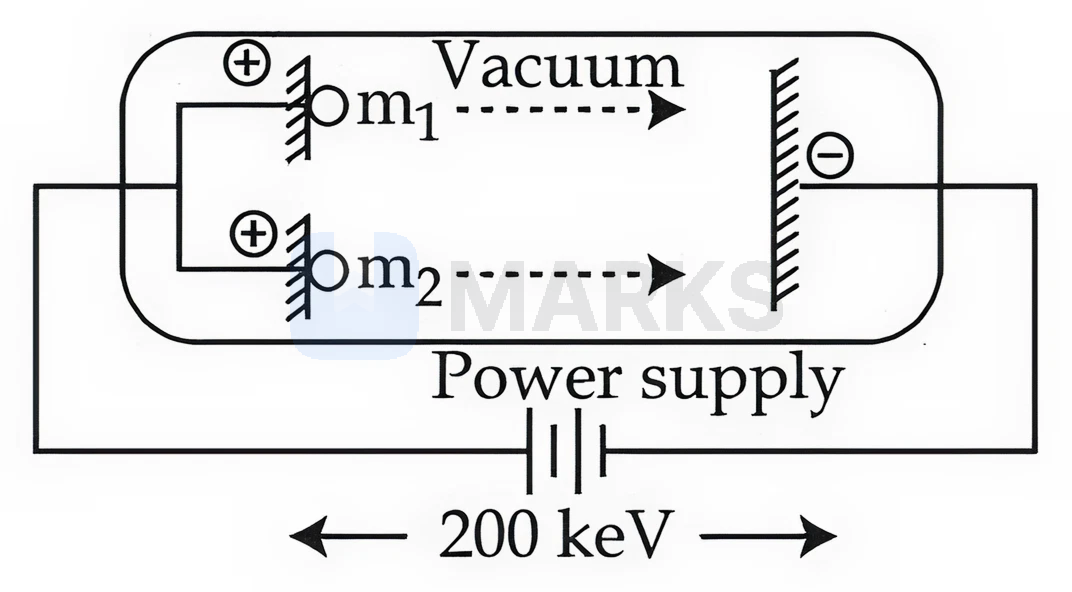
[Given mass of $\mathrm{m}_{1}=1$ amu and $\mathrm{m}_{2}=4$ amu]
The deBroglie wavelength of $\mathrm{m}_{1}$ will be $x$ times of $\mathrm{m}_{2}$. The value of $x$ is $\_\_\_\_$ (nearest integer)
[Given mass of $\mathrm{m}_{1}=1$ amu and $\mathrm{m}_{2}=4$ amu]
The deBroglie wavelength of $\mathrm{m}_{1}$ will be $x$ times of $\mathrm{m}_{2}$. The value of $x$ is $\_\_\_\_$ (nearest integer)
Correct answer: 2
Solution
For a charged particle accelerated through potential V, the de Broglie wavelength is $\lambda = \frac{h}{\sqrt{2mVe}}$.
The wavelength is inversely proportional to $\sqrt{m}$.
Therefore: $\frac{\lambda_1}{\lambda_2} = \sqrt{\frac{m_2}{m_1}} = \sqrt{\frac{4}{1}} = 2$.
This means $\lambda_1 = 2\lambda_2$, so x = 2 (nearest integer).
The wavelength is inversely proportional to $\sqrt{m}$.
Therefore: $\frac{\lambda_1}{\lambda_2} = \sqrt{\frac{m_2}{m_1}} = \sqrt{\frac{4}{1}} = 2$.
This means $\lambda_1 = 2\lambda_2$, so x = 2 (nearest integer).
Hence, the correct answer is 2.