Q101 / 180 · AIIMS 2001 · Physics
Two masses are attached to a rod end to end. If torque is applied they rotate with angular acceleration $\alpha$. If their distances are doubled and same torque is applied, then they move with angular acceleration
- A$4 \alpha$
- B$\alpha$
- C$3 \alpha$
- Correct answerD$\alpha / 4$
Solution
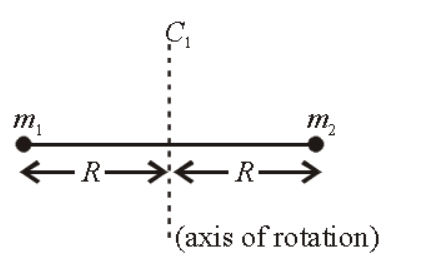
Suppose the masses $m_1$ and $m_2$ are attached to the ends of a massless rod. $C_1$ is the axis of rotation which is at a distance $R$ from each of the masses. $\therefore$ the moment of inertia of the system, $$ \mathrm{I}=m_1 R^2+m_2 R^2=\left(m_1+m_2\right) R^2 $$ Now if the distance between the masses is doubled, then the moment of inertia $$ \Gamma=m_1(2 R)^2+m_2(2 R)^2=\left(m_1+m_2\right) 4 R^2 $$ Since the same torque is applied in both the cases, $$ \begin{aligned} & \tau=I \alpha=I^{\prime} \alpha^{\prime} \\ & \Rightarrow \alpha^{\prime}=\frac{I \alpha}{I^{\prime}}=\frac{\left(m_1+m_2\right) R^2 \alpha}{\left(m_1+m_2\right) 4 R^2}=\frac{\alpha}{4} \end{aligned} $$
Hence, the correct answer is option: 'D'.