Q42 / 48 · JEE Advanced 2025 (Paper 1) · Physics
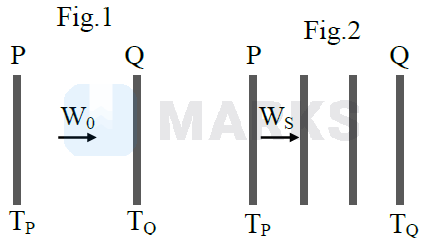
Two identical plates P and Q , radiating as perfect black bodies, are kept in vacuum at constant absolute temperatures \(\mathrm{T}_{\mathrm{P}}\) and \(\mathrm{T}_{\mathrm{Q}}\), respectively, with \(\mathrm{T}_{\mathrm{Q}}<\mathrm{T}_{\mathrm{P}}\), as shown in Fig. 1. The radiated power transferred per unit area from P to Q is \(W_0\). Subsequently, two more plates, identical to P and Q, are introduced between P and Q, as shown in Fig. 2. Assume that heat transfer takes place only between adjacent plates. If the power transferred per unit area in the direction from P to Q (Fig. 2) in the steady state is \(W_S\), then the ratio \(\frac{W_0}{W_S}\) is ________.
Correct answer: 3
Solution
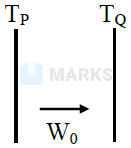
Initially :
$\mathrm{W}_0=\sigma\left(\mathrm{T}_{\mathrm{P}}^4-\mathrm{T}_{\mathrm{Q}}^4\right)$
Finally :
Putting heat currents equal in steady state :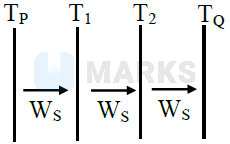
$\begin{aligned} & \sigma\left(\mathrm{T}_{\mathrm{P}}^4-\mathrm{T}_1^4\right)=\sigma\left(\mathrm{T}_1^4-\mathrm{T}_2^4\right) \\ & \sigma\left(\mathrm{T}_1^4-\mathrm{T}_2^4\right)=\sigma\left(\mathrm{T}_2^4-\mathrm{T}_{\mathrm{Q}}^4\right)\end{aligned}$ Adding : $\mathrm{T}_{\mathrm{P}}^4-\mathrm{T}_1^4=\mathrm{T}_2^4-\mathrm{T}_{\mathrm{Q}}^4$ $\Rightarrow \mathrm{T}_1^4+\mathrm{T}_2^4=\mathrm{T}_{\mathrm{P}}^4+\mathrm{T}_{\mathrm{Q}}^4$ and $\quad \Rightarrow \mathrm{T}_1^4-\mathrm{T}_2^4=\mathrm{T}_{\mathrm{P}}^4-\mathrm{T}_1^4$ Adding : $\mathrm{T}_1^4=\frac{2 \mathrm{~T}_{\mathrm{P}}^4+\mathrm{T}_{\mathrm{Q}}^4}{3}$ So $\mathrm{W}_{\mathrm{S}}=\sigma\left(\mathrm{T}_{\mathrm{P}}^4-\mathrm{T}_1^4\right)$ $=\sigma\left(\mathrm{T}_{\mathrm{P}}^4-\left(\frac{2 \mathrm{~T}_{\mathrm{P}}^4+\mathrm{T}_{\mathrm{Q}}^4}{3}\right)\right)=\sigma\left(\frac{\mathrm{T}_{\mathrm{P}}^4-\mathrm{T}_{\mathrm{Q}}^4}{3}\right)$ hence $\frac{\mathrm{W}_{\mathrm{S}}}{\mathrm{W}_0}=3$
Finally :
Putting heat currents equal in steady state :
$\begin{aligned} & \sigma\left(\mathrm{T}_{\mathrm{P}}^4-\mathrm{T}_1^4\right)=\sigma\left(\mathrm{T}_1^4-\mathrm{T}_2^4\right) \\ & \sigma\left(\mathrm{T}_1^4-\mathrm{T}_2^4\right)=\sigma\left(\mathrm{T}_2^4-\mathrm{T}_{\mathrm{Q}}^4\right)\end{aligned}$ Adding : $\mathrm{T}_{\mathrm{P}}^4-\mathrm{T}_1^4=\mathrm{T}_2^4-\mathrm{T}_{\mathrm{Q}}^4$ $\Rightarrow \mathrm{T}_1^4+\mathrm{T}_2^4=\mathrm{T}_{\mathrm{P}}^4+\mathrm{T}_{\mathrm{Q}}^4$ and $\quad \Rightarrow \mathrm{T}_1^4-\mathrm{T}_2^4=\mathrm{T}_{\mathrm{P}}^4-\mathrm{T}_1^4$ Adding : $\mathrm{T}_1^4=\frac{2 \mathrm{~T}_{\mathrm{P}}^4+\mathrm{T}_{\mathrm{Q}}^4}{3}$ So $\mathrm{W}_{\mathrm{S}}=\sigma\left(\mathrm{T}_{\mathrm{P}}^4-\mathrm{T}_1^4\right)$ $=\sigma\left(\mathrm{T}_{\mathrm{P}}^4-\left(\frac{2 \mathrm{~T}_{\mathrm{P}}^4+\mathrm{T}_{\mathrm{Q}}^4}{3}\right)\right)=\sigma\left(\frac{\mathrm{T}_{\mathrm{P}}^4-\mathrm{T}_{\mathrm{Q}}^4}{3}\right)$ hence $\frac{\mathrm{W}_{\mathrm{S}}}{\mathrm{W}_0}=3$
Hence, the correct answer is 3.