Q99 / 270 · NDA 2015 (Phase 2) · General Ability
Two forces, one of 3 newton and another of 4 newton are applied on a standard 1 kg body, placed on a horizontal and frictionless surface, simultaneously along the x -axis and the y-axis, respectively, as shown below:
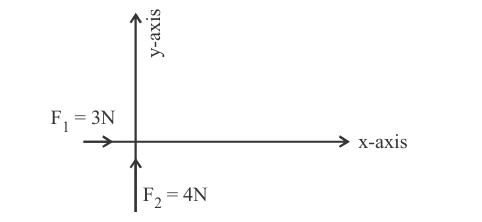
The magnitude of the resultant acceleration is:
The magnitude of the resultant acceleration is:
- A$7 \mathrm{~m} / \mathrm{s}^2$
- B$1 \mathrm{~m} / \mathrm{s}^2$
- Correct answerC$5 \mathrm{~m} / \mathrm{s}^2$
- D$\sqrt{7} \mathrm{~m} / \mathrm{s}^2$
Solution
Final force will be along the Z axis.
$F=\sqrt{ }(3)^2+(4)^2$
$\begin{aligned} & =\sqrt{ } 9+16=\sqrt{ } 25=5 \\ & \text {Acceleration }(a)=F / m=5 / 1=5 \mathrm{~m} / \mathrm{s}^2\end{aligned}$
Hence, the correct answer is option: 'C'.