Q54 / 75 · JEE Main 2026 (06 April Shift 1) · Physics
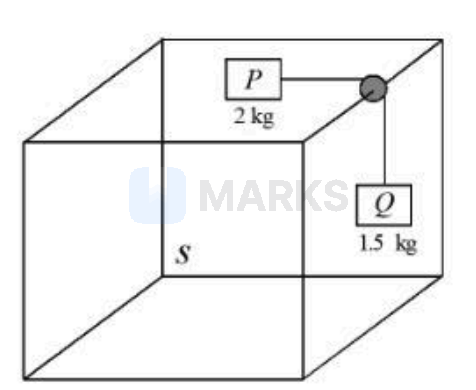
Two blocks ($P$ and $Q$) with respectively masses $2$ kg and $1.5$ kg are joined by a massless thread. These blocks are mounted on a frictionless pulley which is fixed on the edge of a cube ($S$), as shown in the figure below. Block $P$ is positioned on the top surface which has no friction and block $Q$ is in contact with side-surface, having coefficient friction $\mu$. The cube ($S$) moves towards the right with acceleration of $\dfrac{g}{2}$, where $g$ is gravitational acceleration. During this movement the block $P$ and $Q$ remain stationary. The value of $\mu$ is _______. (take $g = 10$ m/s$^2$)
- A$0.33$
- Correct answerB$0.67$
- C$1$
- D$0.5$
Solution
Let us analyze the forces acting on blocks $P$ and $Q$ in the non-inertial frame of reference of the cube $S$, which is moving to the right with an acceleration $a = \dfrac{g}{2} = 5 \text{ m/s}^2$.
In this frame, a pseudo force acts on both blocks towards the left.
For block $P$ (mass $m_P = 2 \text{ kg}$):
The forces in the horizontal direction are the tension $T$ in the string (acting towards the right) and the pseudo force $F_{pP}$ (acting towards the left). Since block $P$ is stationary relative to the cube and there is no friction on the top surface:
$T = m_P a = 2 \times 5 = 10 \text{ N}$
For block $Q$ (mass $m_Q = 1.5 \text{ kg}$):
The horizontal forces are the normal reaction $N$ from the side surface of the cube (acting towards the right) and the pseudo force $F_{pQ}$ (acting towards the left). Since block $Q$ is stationary horizontally relative to the cube:
$N = m_Q a = 1.5 \times 5 = 7.5 \text{ N}$
The vertical forces acting on block $Q$ are the downward gravitational force $m_Q g$, the upward tension $T$, and the frictional force $f$.
The downward force is $m_Q g = 1.5 \times 10 = 15 \text{ N}$.
Since $m_Q g > T$ ($15 \text{ N} > 10 \text{ N}$), the block has a tendency to slide downwards, so the static friction $f$ must act upwards.
For vertical equilibrium of block $Q$:
$T + f = m_Q g$
$10 + f = 15 \Rightarrow f = 5 \text{ N}$
To keep the block stationary, the required friction must be less than or equal to the maximum static friction ($f \le \mu N$). Assuming the limiting case to find the value of $\mu$:
$\mu N = f$
$\mu (7.5) = 5$
$\mu = \dfrac{5}{7.5} = \dfrac{2}{3} \approx 0.67$
Answer: $0.67$
Hence, the correct answer is option: 'B'.