Q105 / 120 · VITEEE 2007 · Physics
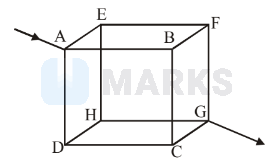
Twelve wires of each of resistance 6 ohms are connected to form a cube as shown in the figure. The current enters at a corner $A$ and leaves at the diagonally opposite corner $\mathrm{G}$. The joint resistance across the corners $\mathrm{A}$ and $\mathrm{G}$ are
- A$12 \mathrm{ohms}$
- B6 ohms
- C$3 \mathrm{ohms}$
- Correct answerD$5 \mathrm{ohms}$
Solution
Let a total current of 6 I enter at A. It divides into three equal parts, each of $2 \mathrm{I}$, along $\mathrm{AE}$, $\mathrm{AB}$ and $\mathrm{AD}$. At $\mathrm{E}, \mathrm{B}$ and $\mathrm{D}$ each the current 2I divides into two equal parts, each of $\mathrm{I}$, along $\mathrm{EF}, \mathrm{EH}, \mathrm{BF}, \mathrm{BC}, \mathrm{DH}$ and $\mathrm{DC}$.
At $\mathrm{F}, \mathrm{H}$ and $\mathrm{C}$, the two currents each of $\mathrm{I}$, combine together to give a current of $2 \mathrm{I}$ at each corner. Thus, at $\mathrm{G}$ we get the same current 6 I as shown in the figure.
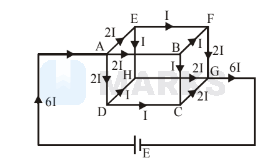
Let $\mathrm{r}$ be the value of resistance of each $\mathrm{arm}$ of the cube and $\mathrm{R}$ be the joint resistance across the conners A and G. Applying Kirchhoff's law along the loop AEFGA, we get $2 \mathrm{Ir}+\mathrm{Ir}+2 \mathrm{Ir}=\mathrm{E}$ or $5 \mathrm{Ir}=\mathrm{E}$ ...(1) Also, by Ohm's law, $\begin{array}{l} 6 \mathrm{I} \times \mathrm{R}=\mathrm{E} \\ \Rightarrow 6 \mathrm{IR}=5 \mathrm{Ir}, \text { using }(1) \end{array}$ or, $\mathrm{R}=\frac{5}{6} \mathrm{r}$. Here, $r=6 \Omega$ $\therefore \mathrm{R}=\frac{5}{6} \times 6=5 \Omega$
Let $\mathrm{r}$ be the value of resistance of each $\mathrm{arm}$ of the cube and $\mathrm{R}$ be the joint resistance across the conners A and G. Applying Kirchhoff's law along the loop AEFGA, we get $2 \mathrm{Ir}+\mathrm{Ir}+2 \mathrm{Ir}=\mathrm{E}$ or $5 \mathrm{Ir}=\mathrm{E}$ ...(1) Also, by Ohm's law, $\begin{array}{l} 6 \mathrm{I} \times \mathrm{R}=\mathrm{E} \\ \Rightarrow 6 \mathrm{IR}=5 \mathrm{Ir}, \text { using }(1) \end{array}$ or, $\mathrm{R}=\frac{5}{6} \mathrm{r}$. Here, $r=6 \Omega$ $\therefore \mathrm{R}=\frac{5}{6} \times 6=5 \Omega$
Hence, the correct answer is option: 'D'.