Q150 / 150 · MHT CET 2026 (17 April Shift 1) · Physics
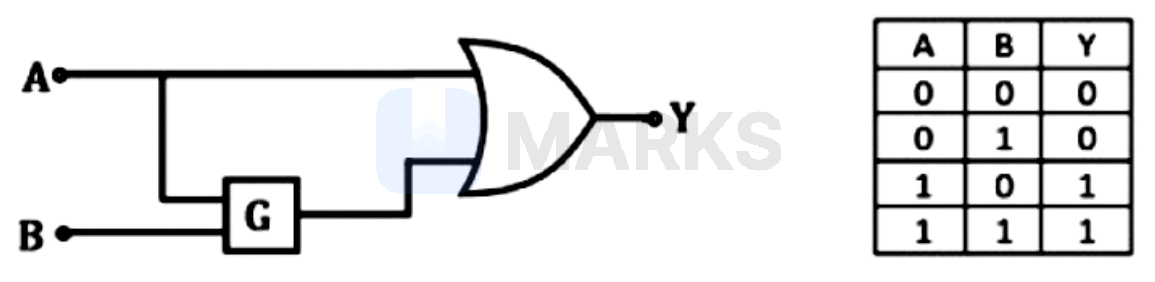
To get the truth table shown from the following logic circuit, the gate G should be
- ANAND gate.
- BNOR gate.
- Correct answerCAND gate.
- DOR gate.
Solution
From the given logic circuit, the output $Y$ is given by the Boolean expression:
$Y = A + G(A, B)$
From the given truth table, we can observe that the output $Y$ is identical to the input $A$ for all combinations of $A$ and $B$.
Thus, $Y = A$.
Equating the two expressions for $Y$, we get:
$A + G(A, B) = A$
Let us check the given options for gate G:
If G is an AND gate, $G(A, B) = A \cdot B$.
Then, $Y = A + A \cdot B = A(1 + B) = A \cdot 1 = A$.
This perfectly matches the required condition.
Checking other options:
If G is an OR gate, $Y = A + (A + B) = A + B \neq A$.
If G is a NAND gate, $Y = A + \overline{A \cdot B}$. For $A=0, B=0$, $Y = 0 + 1 = 1 \neq 0$.
If G is a NOR gate, $Y = A + \overline{A + B}$. For $A=0, B=0$, $Y = 0 + 1 = 1 \neq 0$.
Therefore, the gate G must be an AND gate.
Answer: AND gate.
Hence, the correct answer is option: 'C'.