Q7 / 68 · NEST (NISER) 2023 (Session 2) · Biology
Tissue damage alters the surface-adhesive behaviour of leukocytes resulting in leukocyte rolling. This involves several cycles of attachment and detachment of leukocytes on the surface of endothelial cells. Given that the typical rupture force for a ligand-receptor pair is 25 pN , multiple bonds must be formed at the same time to provide the necessary counterbalance to the shear force exerted by the flowing blood. The general schematic is depicted below.
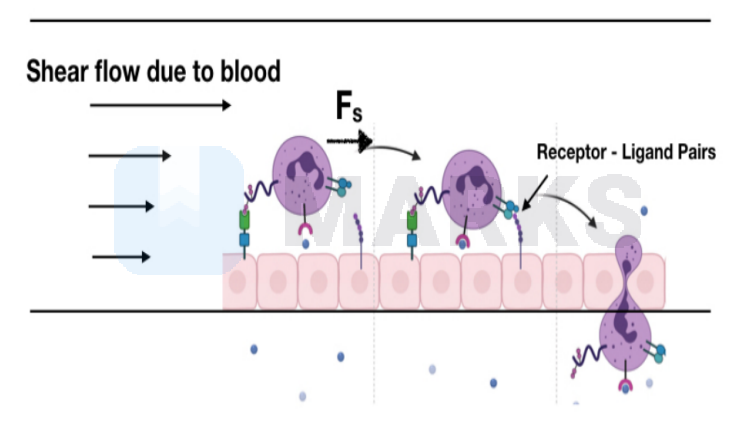
Consider the effective cross-sectional area of the cell that experiences the shear and the following parameters.
$\begin{array}{|l|c|} \hline \text{Leukocyte radius (approximated to be a sphere)} & 5 \mu \mathrm{~m} \\ \hline \text{Rolling velocity} & 10 \mu \mathrm{~m} / \mathrm{s} \\ \hline \text{Shear Stress due to blood flow} & 1 \mathrm{~N} / \mathrm{m}^2 \\ \hline \end{array}$
Among the given options, the minimum number of ligand-receptor pairs (bonds) that need to form at the same time to provide the counterforce against the shear force to stop the leukocyte rolling is
- A15 ligand-receptor pair
- B10 ligand-receptor pair
- C2 ligand-receptor pair
- Correct answerD5 ligand-receptor pair
Hence, the correct answer is option: 'D'.