Q133 / 150 · MHT CET 2026 (18 April Shift 2) · Physics
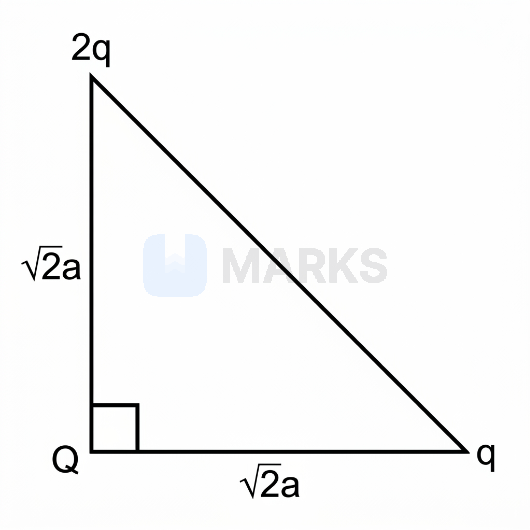
Three point charges Q, $+2q$ and $+q$ are placed at the vertices of a right-angled isosceles triangle of length $\sqrt{2}a$ as shown in figure. The net electrostatic potential energy of the configuration is zero, if Q is equal to
- A$-\dfrac{1}{2\sqrt{3}}q$
- Correct answerB$-\dfrac{\sqrt{2}}{3}q$
- C$-\dfrac{\sqrt{3}}{2}q$
- D$-\sqrt{\dfrac{2}{3}}\,q$
Solution
The net electrostatic potential energy of a system of three charges is given by the sum of the potential energies of all pairs of charges.
Let the charges be $q_1 = Q$, $q_2 = 2q$, and $q_3 = q$.
From the given right-angled isosceles triangle, the distances between the charges are:
Distance between $Q$ and $2q$, $r_{12} = \sqrt{2}a$
Distance between $Q$ and $q$, $r_{13} = \sqrt{2}a$
Distance between $2q$ and $q$ (hypotenuse), $r_{23} = \sqrt{(\sqrt{2}a)^2 + (\sqrt{2}a)^2} = \sqrt{2a^2 + 2a^2} = \sqrt{4a^2} = 2a$
The net potential energy $U$ is:
$U = \dfrac{1}{4\pi\epsilon_0} \left( \dfrac{q_1 q_2}{r_{12}} + \dfrac{q_1 q_3}{r_{13}} + \dfrac{q_2 q_3}{r_{23}} \right)$
Substituting the values:
$U = \dfrac{1}{4\pi\epsilon_0} \left( \dfrac{Q(2q)}{\sqrt{2}a} + \dfrac{Q(q)}{\sqrt{2}a} + \dfrac{(2q)(q)}{2a} \right)$
Given that the net electrostatic potential energy is zero ($U = 0$):
$\dfrac{2qQ}{\sqrt{2}a} + \dfrac{qQ}{\sqrt{2}a} + \dfrac{2q^2}{2a} = 0$
Dividing the equation by $\dfrac{q}{a}$:
$\dfrac{2Q}{\sqrt{2}} + \dfrac{Q}{\sqrt{2}} + q = 0$
$\dfrac{3Q}{\sqrt{2}} + q = 0$
$\dfrac{3Q}{\sqrt{2}} = -q$
$Q = -\dfrac{\sqrt{2}}{3}q$
Answer: $-\dfrac{\sqrt{2}}{3}q$
Hence, the correct answer is option: 'B'.