Q55 / 56 · IAT (IISER) 2026 · Physics
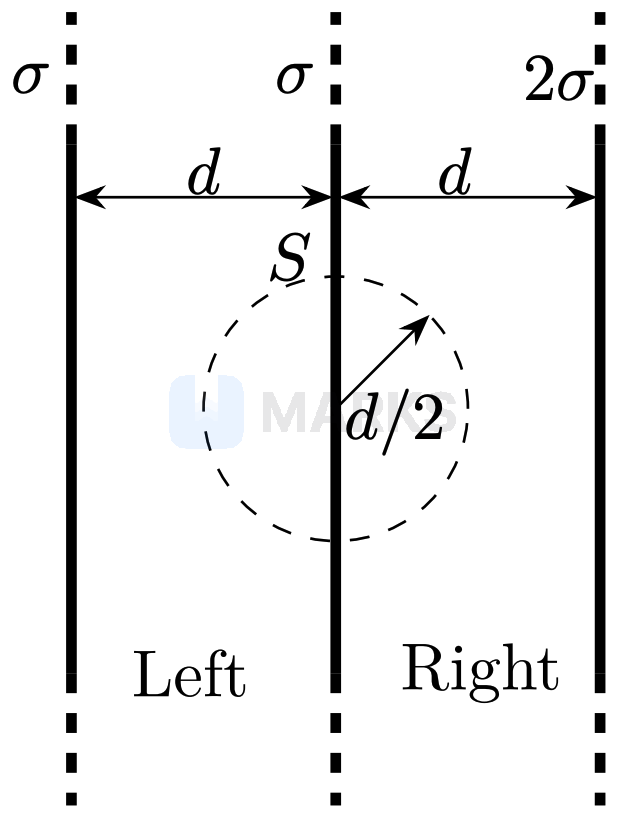
Three infinite plane sheets which have uniform positive surface charge densities $\sigma$, $\sigma$ and $2\sigma$, are arranged parallel to each other with a separation of $d$ as shown in the figure. A spherical Gaussian surface $S$ of radius $d/2$ has its center on the middle sheet. Which of the following statements regarding the electric flux $\Phi_L$ through the left hemisphere and the electric flux $\Phi_R$ through the right hemisphere of the Gaussian surface is correct?
- A$\Phi_L = \Phi_R$.
- B$\Phi_L = 2\Phi_R$.
- C$\Phi_L < \Phi_R$.
- Correct answerD$\Phi_L > \Phi_R$.
Solution
Let the middle sheet be located at $x = 0$. Then the left sheet is at $x = -d$ and the right sheet is at $x = d$.
The electric field in the region between the left and middle sheets ($-d < x < 0$), where the left hemisphere lies, is the superposition of the fields from all three sheets. Taking the rightward direction as positive:
$E_L = E_{\text{left}} + E_{\text{middle}} + E_{\text{right}}$
$E_L = \dfrac{\sigma}{2\epsilon_0} - \dfrac{\sigma}{2\epsilon_0} - \dfrac{2\sigma}{2\epsilon_0} = -\dfrac{\sigma}{\epsilon_0}$
The electric field $E_L$ is non-zero and points towards the left. Since the outward normal of the left hemisphere also points leftwards, the electric flux through the left hemisphere is positive ($\Phi_L > 0$).
The electric field in the region between the middle and right sheets ($0 < x < d$), where the right hemisphere lies, is:
$E_R = E_{\text{left}} + E_{\text{middle}} + E_{\text{right}}$
$E_R = \dfrac{\sigma}{2\epsilon_0} + \dfrac{\sigma}{2\epsilon_0} - \dfrac{2\sigma}{2\epsilon_0} = 0$
Since the electric field is zero everywhere on the right hemisphere, the electric flux through the right hemisphere is zero ($\Phi_R = 0$).
Comparing the two fluxes, we get $\Phi_L > \Phi_R$.
Answer: $\Phi_L > \Phi_R$.
Hence, the correct answer is option: 'D'.