Q145 / 150 · MHT CET 2026 (11 April Shift 1) · Physics
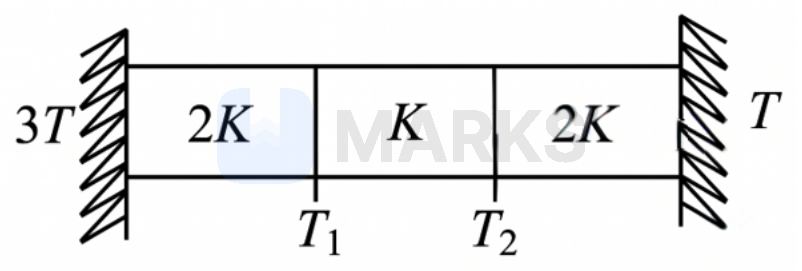
Three identical heat conducting rods are connected in series as shown in the figure. The rods on the side have thermal conductivity $2K$ while that in the middle has thermal conductivity $K$. The left end of the combination is maintained at temperature $3T$ and the right end at $T$. The rods are thermally insulated from outside. In steady state, temperature at the left junction is $T_1$ and that at the right junctions is $T_2$. The ratio $T_1/T_2$ is
- A$\dfrac{3}{2}$
- B$\dfrac{4}{3}$
- Correct answerC$\dfrac{5}{3}$
- D$\dfrac{4}{5}$
Solution
Let the length of each rod be $L$ and the area of cross-section be $A$.
In steady state, the rate of heat flow is the same through all three rods:
$\dfrac{dQ}{dt} = \dfrac{2KA(3T - T_1)}{L} = \dfrac{KA(T_1 - T_2)}{L} = \dfrac{2KA(T_2 - T)}{L}$
Cancelling $\dfrac{KA}{L}$ from all terms, we get:
$2(3T - T_1) = T_1 - T_2 = 2(T_2 - T)$
From the first and third parts of the equality:
$2(3T - T_1) = 2(T_2 - T)$
$3T - T_1 = T_2 - T$
$T_1 + T_2 = 4T \quad \dots (1)$
From the second and third parts of the equality:
$T_1 - T_2 = 2(T_2 - T)$
$T_1 - 3T_2 = -2T \quad \dots (2)$
Subtracting equation (2) from equation (1):
$(T_1 + T_2) - (T_1 - 3T_2) = 4T - (-2T)$
$4T_2 = 6T \Rightarrow T_2 = \dfrac{3T}{2}$
Substituting $T_2$ in equation (1):
$T_1 + \dfrac{3T}{2} = 4T \Rightarrow T_1 = \dfrac{5T}{2}$
The required ratio is:
$\dfrac{T_1}{T_2} = \dfrac{\dfrac{5T}{2}}{\dfrac{3T}{2}} = \dfrac{5}{3}$
Answer: $\dfrac{5}{3}$
Hence, the correct answer is option: 'C'.