Q141 / 150 · MHT CET 2025 (23 Apr Shift 1) · Physics
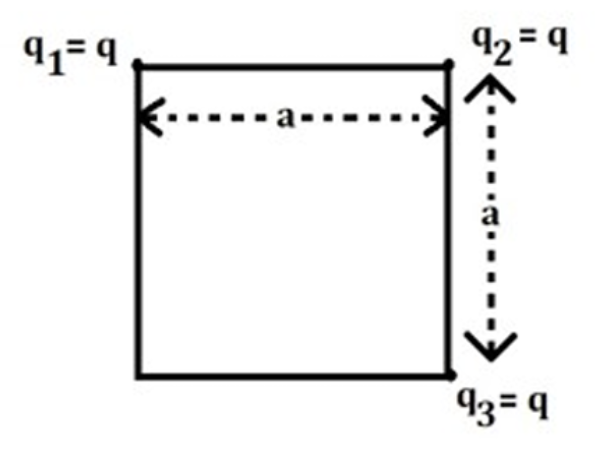
Three equal charges are placed on the three corners of a square as shown below. If the magnitude of force between ' $\mathrm{q}_1$ ' and ' $\mathrm{q}_2$ ' is ' $\mathrm{F}_{12}$ ' and that between ' $\mathrm{q}_1{ }^{\prime}$ and ' $\mathrm{q}_3{ }^{\prime}$ is $\mathrm{F}_{13}$, then the ratio of $\mathrm{F}_{13}$ to $\mathrm{F}_{12}$ is
- A$\frac{1}{\sqrt{2}}$
- B$\sqrt{2}$
- Correct answerC$\frac{1}{2}$
- D$2$
Solution
The ratio of the electrostatic forces between charges is determined using Coulomb’s Law, $F = k \frac{|q_1 q_2|}{r^2}$, with all charges equal to $q$.
Force between adjacent charges: For $q_1$ and $q_2$ on adjacent corners of the square, the separation is $r_{12} = a$, giving $F_{12} = \frac{kq^2}{a^2}$.
Force between opposite charges: For $q_1$ and $q_3$ on opposite corners, the diagonal distance is $r_{13} = a\sqrt{2}$, yielding $F_{13} = \frac{kq^2}{(a\sqrt{2})^2} = \frac{kq^2}{2a^2}$.
The ratio is thus $\frac{F_{13}}{F_{12}} = \frac{\frac{kq^2}{2a^2}}{\frac{kq^2}{a^2}} = \frac{1}{2}$, corresponding to option $\boxed{\text{C}}$.
Hence, the correct answer is option: 'C'.