Q90 / 90 · KVPY 2010 (SB/SX) · Physics
Three equal charges $+\mathrm{q}$ are placed at the three vertices of an equilateral triangle centered at the origin. They are held in equilibrium by a restoring force of magnitude $F(r)=k r$ directed towards the origin, where $k$ is a constant. What is the distance of the three charges from the origin?
- A$\left[\frac{1}{6 \pi \varepsilon_{0}} \frac{\mathrm{q}^{2}}{\mathrm{k}}\right]^{1 / 2}$
- Correct answerB$\left[\frac{\sqrt{3}}{12 \pi \varepsilon_{0}} \frac{\mathrm{q}^{2}}{\mathrm{k}}\right]^{1 / 3}$
- C$\left[\frac{1}{6 \pi \varepsilon_{0}} \frac{\mathrm{q}^{2}}{\mathrm{k}}\right]^{2 / 3}$
- D$\left[\frac{\sqrt{3}}{4 \pi \varepsilon_{0}} \frac{\mathrm{q}^{2}}{\mathrm{k}}\right]^{2 / 3}$
Solution
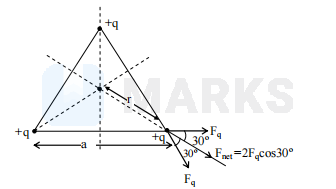
$$ F(r)=k T $$ now $F_{\text {net }}$ on a particle is $2 F_{q} \cos 30^{\circ}$ due to the other two charges $$ \mathrm{F}_{\mathrm{net}}=\frac{2 \mathrm{kq}^{2}}{\mathrm{a}^{2}} \times \frac{\sqrt{3}}{2} $$ also $r=\frac{2}{3}\left(\frac{\sqrt{3}}{2} a\right)$ $\therefore \mathrm{a}=\sqrt{3} \mathrm{r}$ replacing it in $\mathrm{F}_{\text {nat }}$ we get $$ \mathrm{F}_{\mathrm{net}}=\frac{2 \mathrm{kq}^{2}}{(\sqrt{3} \mathrm{r})^{2}} \times\left(\frac{\sqrt{3}}{2}\right)=\frac{\mathrm{kq}^{2}}{\sqrt{3} \mathrm{r}^{2}} $$ this is balanced by $\mathrm{F}(\mathrm{r})$ $$ \begin{array}{l} \therefore F(r)=F_{n e t} \Rightarrow k r=\frac{1 \times q^{2}}{4 \pi \varepsilon_{0} \times \sqrt{3} r^{2}} \\ \therefore r=\left(\frac{\sqrt{3} q^{2}}{12 \pi \varepsilon_{0} k}\right)^{1 / 3} \end{array} $$
Hence, the correct answer is option: 'B'.