Q178 / 180 · COMEDK 2025 (10 May Shift 3) · Physics
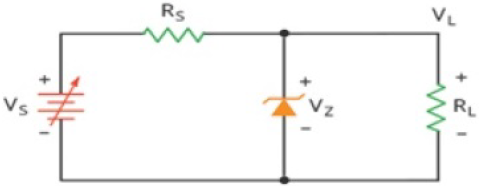
The zener voltage in the circuit shown is $\mathrm{V}_{\mathrm{Z}}=20 \mathrm{~V}$. The load resistance $\mathrm{R}_{\mathrm{L}}=5 \mathrm{k} \Omega$ and the resistance $\mathrm{R} \mathrm{s}=10 \mathrm{k} \Omega$. If the input voltage is $\mathrm{V} \mathrm{s}=100 \mathrm{~V}$, then the current through the zener diode in milliampere is:
- A$8$
- B$5$
- Correct answerC$4$
- D$6$
Solution
The circuit is a Zener diode voltage regulator. The Zener diode is connected in parallel with the load resistor $R_L$.
Given values:
$V_S = 100 \text{ V}$
$R_S = 10 \text{ k}\Omega = 10000 \text{ }\Omega$
$R_L = 5 \text{ k}\Omega = 5000 \text{ }\Omega$
$V_Z = 20 \text{ V}$
Since the Zener diode is in parallel with the load resistor $R_L$, the voltage across the load resistor $V_L$ is equal to the Zener voltage $V_Z$.
$V_L = V_Z = 20 \text{ V}$
The total current $I$ flowing through the series resistor $R_S$ is given by:
$I = \dfrac{V_S - V_Z}{R_S} = \dfrac{100 - 20}{10000} = \dfrac{80}{10000} = 8 \times 10^{-3} \text{ A} = 8 \text{ mA}$
The current flowing through the load resistor $I_L$ is:
$I_L = \dfrac{V_L}{R_L} = \dfrac{20}{5000} = 4 \times 10^{-3} \text{ A} = 4 \text{ mA}$
Applying Kirchhoff's Current Law at the node connecting $R_S$, the Zener diode, and $R_L$, the current through the Zener diode $I_Z$ is:
$I_Z = I - I_L = 8 \text{ mA} - 4 \text{ mA} = 4 \text{ mA}$
Answer: $4$
Hence, the correct answer is option: 'C'.