Q139 / 180 · COMEDK 2026 (9 May Shift 2) · Physics
The variation of the stopping potential ($V_0$) with the frequency of incident radiation(n) is as given below.
[$n_0$ - threshold frequency. h- Planck's constant e- electronic charge] then the slope of the graph AB with the frequency axis is:
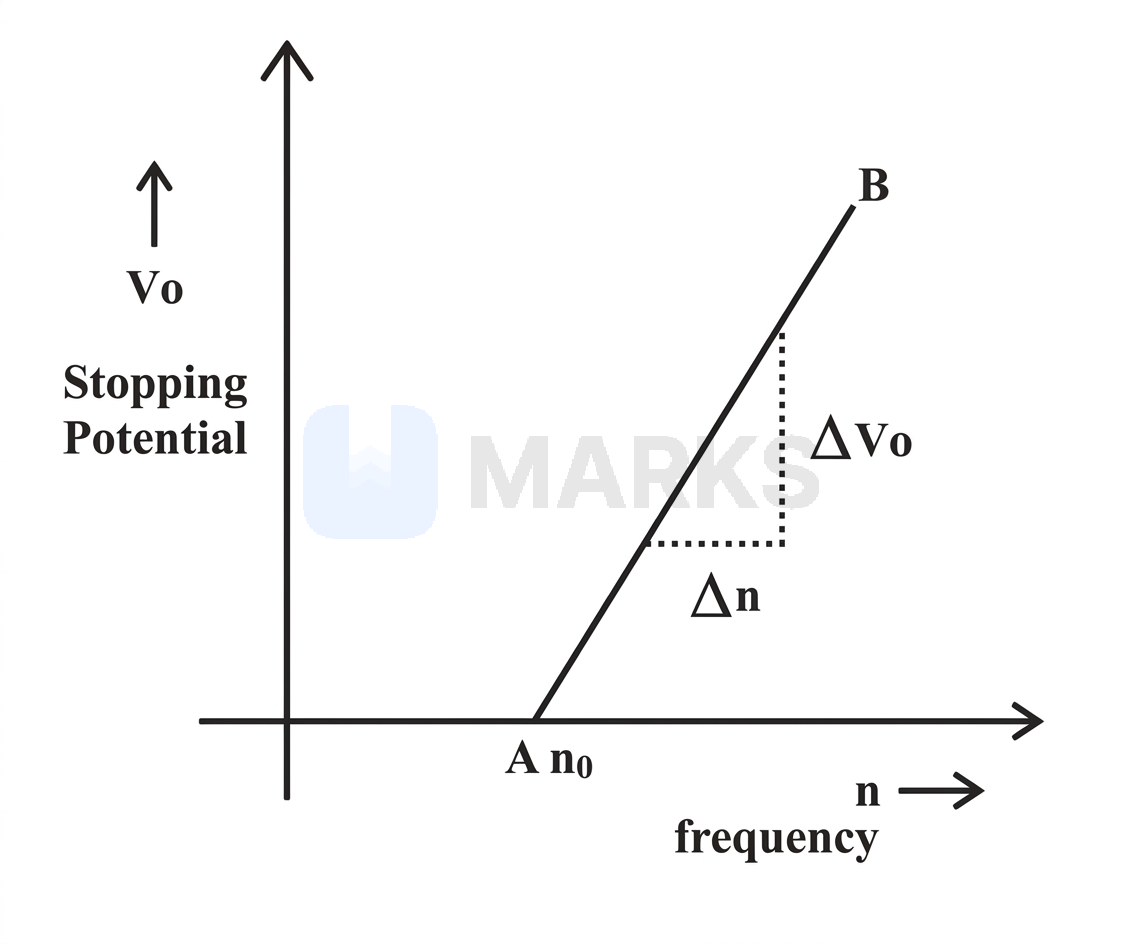
[$n_0$ - threshold frequency. h- Planck's constant e- electronic charge] then the slope of the graph AB with the frequency axis is:
- Correct answerA$\dfrac{h}{e}$
- B$\dfrac{n_0}{V_0}$
- C$\dfrac{hn_0}{V_0}$
- D$\dfrac{V_0}{n_0}$
Solution
According to Einstein's photoelectric equation, the maximum kinetic energy of emitted photoelectrons is given by:
$K_{\text{max}} = hn - \Phi$
where $h$ is Planck's constant, $n$ is the frequency of incident radiation, and $\Phi$ is the work function of the metal.
We know that $K_{\text{max}} = eV_0$, where $e$ is the charge of an electron and $V_0$ is the stopping potential. Substituting this into the equation, we get:
$eV_0 = hn - \Phi$
$V_0 = \left(\dfrac{h}{e}\right)n - \dfrac{\Phi}{e}$
Comparing this equation with the standard equation of a straight line $y = mx + c$, we have:
$y = V_0$
$x = n$
Slope, $m = \dfrac{h}{e}$
Therefore, the slope of the graph of stopping potential ($V_0$) versus frequency ($n$) is $\dfrac{h}{e}$.
Answer: $\dfrac{h}{e}$
Hence, the correct answer is option: 'A'.