Q93 / 200 · Manipal (MET) 2013 · Mathematics
The values of $\alpha$ for which the point $(\alpha-1, \alpha+1)$ lies in the larger segment of the circle $x^2+y^2-x-y-6=0$ made by the chord whose equation is $x+y-2=0$ is
- Correct answerA$-1 \lt \alpha \lt 1$
- B$1 \lt \alpha \lt \infty$
- C$-\infty \lt \alpha \lt -1$
- D$\alpha \leq 0$
Solution
The given circle
$S(x, y) \equiv x^2+y^2-x-y-6=0$ ....(i)
has centre at $C \equiv\left(\frac{1}{2}, \frac{1}{2}\right)$.
According to the given conditions, the given point $P(\alpha-1, \alpha+1)$ must lie inside the given circle.
i.e., $S(\alpha-1, \alpha+1) \lt 0$
$\begin{aligned} & \Rightarrow(\alpha-1)^2+(\alpha+1)^2-(\alpha-1)-(\alpha+1)-6 \lt 0 \\ & \Rightarrow \alpha^2-\alpha-2 \lt 0 \text { i.e., }(\alpha-2)(\alpha+1) \lt 0 \\ & \Rightarrow-1 \lt \alpha \lt 2\end{aligned}$
[using sign - scheme from algebra] ...(ii)
and also $P$ and $C$ must lie on the same side of the line.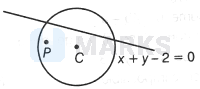
$L(x, y)=x+y-2=0$ i.e., $L\left(\frac{1}{2}, \frac{1}{2}\right)$ and $L(\alpha-1, \alpha+1)$ must have the same sign. Now, Isince $L\left(\frac{1}{2}, \frac{1}{2}\right)=\frac{1}{2}+\frac{1}{2}-2 \lt 0$ therefore, we have $L(\alpha-1, \alpha+1)=(\alpha-1)+(\alpha+1)-2 \lt 0$ $\Rightarrow \quad \alpha \lt 1$ ....(iv) Ineqalities (ii) and (iv) together give the permissible values of $\alpha$ as $-1 \lt \alpha \lt 1$.
$L(x, y)=x+y-2=0$ i.e., $L\left(\frac{1}{2}, \frac{1}{2}\right)$ and $L(\alpha-1, \alpha+1)$ must have the same sign. Now, Isince $L\left(\frac{1}{2}, \frac{1}{2}\right)=\frac{1}{2}+\frac{1}{2}-2 \lt 0$ therefore, we have $L(\alpha-1, \alpha+1)=(\alpha-1)+(\alpha+1)-2 \lt 0$ $\Rightarrow \quad \alpha \lt 1$ ....(iv) Ineqalities (ii) and (iv) together give the permissible values of $\alpha$ as $-1 \lt \alpha \lt 1$.
Hence, the correct answer is option: 'A'.