Q143 / 160 · AP EAMCET 2013 · Physics
The two surfaces of a concave lens, made of glass of refractive index 1.5 have the same radii of curvature $R$. It is now immersed in a medium of refractive index 1.75 , then the lens
- Correct answerAbecomes a convergent lens of focal length $3.5 R$
- Bbecomes a convergent lens of focal length $3.0 R$
- Cchanges as a divergent lens of focal length $3.5 R$
- Dchanges as a divergent lens of focal length $3.0 R$
Solution
From lens maker's formula
$$
\frac{1}{f}=\left({ }_g^m \mu-1\right)\left(\frac{1}{R_1}-\frac{1}{R_2}\right)
$$
Now, $\quad{ }_g^m \mu=\frac{g \mu}{{ }_m \mu}=\frac{1.5}{1.75}$
For concave lens as shown in the figure, in this case
$$
R_1=-R \text { and } R_2=+R
$$
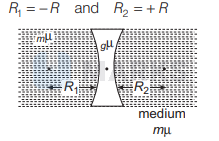
$$ \begin{gathered} \frac{1}{f}=\left(\frac{1.5}{1.75}-1\right)\left(-\frac{1}{R}-\frac{1}{R}\right)=+\frac{0.25 \times 2}{1.75 R} \\ \Rightarrow \quad f=+3.5 R \end{gathered} $$ The positive sign shows that the lens behaves as a convergent lens.
$$ \begin{gathered} \frac{1}{f}=\left(\frac{1.5}{1.75}-1\right)\left(-\frac{1}{R}-\frac{1}{R}\right)=+\frac{0.25 \times 2}{1.75 R} \\ \Rightarrow \quad f=+3.5 R \end{gathered} $$ The positive sign shows that the lens behaves as a convergent lens.
Hence, the correct answer is option: 'A'.